WP_Post Object
(
[ID] => 9933
[post_author] => 20
[post_date] => 2026-02-18 14:30:56
[post_date_gmt] => 2026-02-18 20:30:56
[post_content] =>
In the 1958 film, Auntie Mame, the titular character famously says, "Life is a banquet, and most poor suckers are starving to death!" The film, based on a book that also became a stage play and a musical, is about the flamboyant, unconventional and absolutely fabulous guardian of her orphaned nephew. She teaches him to embrace joy, challenge societal norms, and say "yes" to life's adventures.
"To us, Lyn was Auntie Mame," says Benaron Gleiberman, Lyn Goldman's nephew. "It was one of her favourite acting roles when she was involved in Regina Little Theatre, and it was a good reflection of her life and activities,"
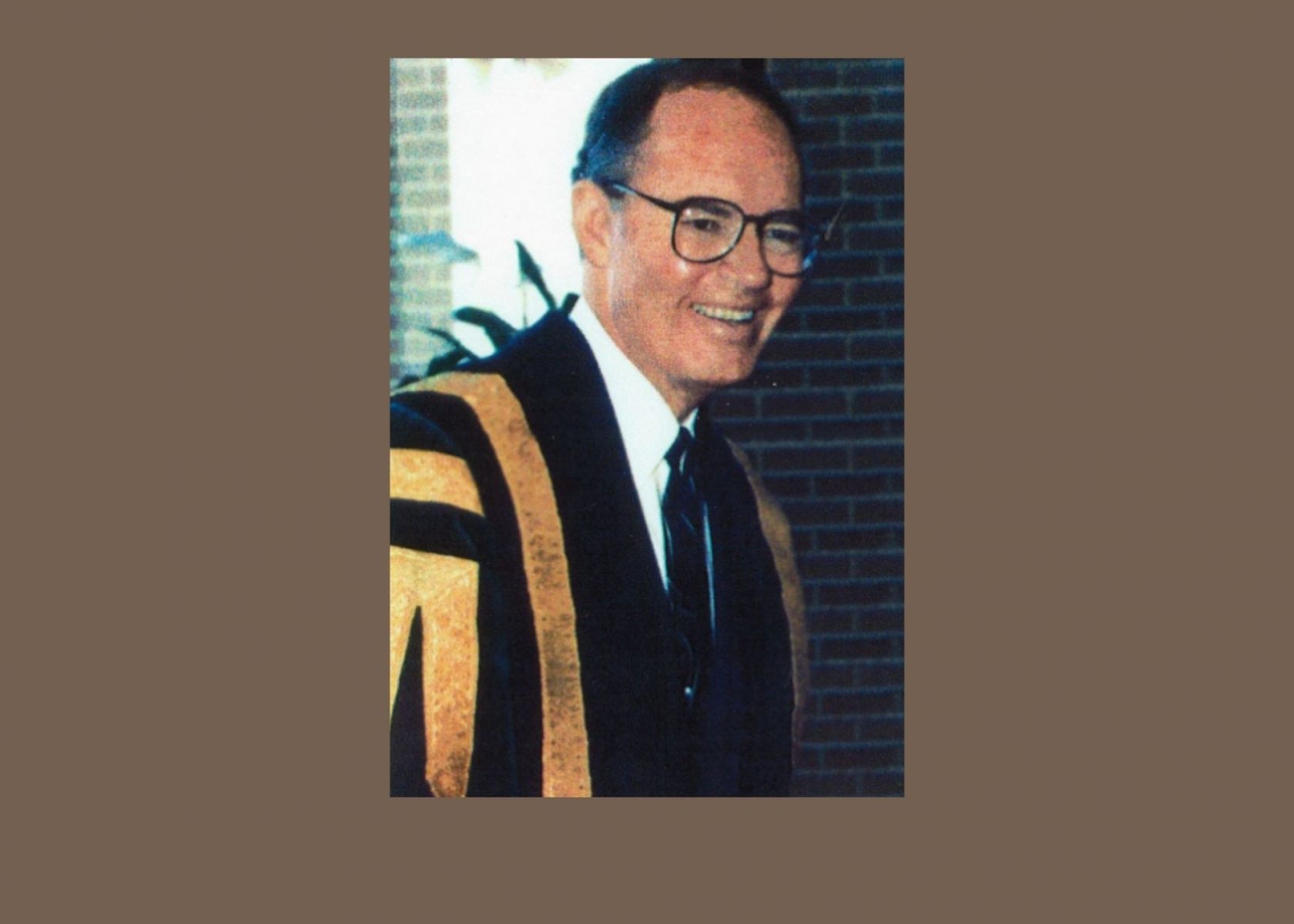
Lyn Goldman (1932 - 2026) spent her life ensuring that people in Regina have opportunities to enjoy a banquet of creativity in their community; the impact of her efforts will continue to resonate for generations after her passing. For example, just days before her death on January 13, she launched the $50,000 Thorn Prize in honour of her late brother Anthony. The prize will be awarded biennially to support a mid-career artist in Canada through a "self-directed period of exploration", including travel and living expenses, culminating in a solo exhibition at the MacKenzie Art Gallery in Regina.
"Lyn was a remarkable force in our community…. Her contributions to Saskatchewan and Canada's cultural landscape are immeasurable," says John G. Hampton, executive director and CEO of the MacKenzie Art Gallery. "One of her final acts was one of service to her community, art, and artists; of celebration and elevation; something genuinely useful. Lyn spent her life in service to her community, always supporting where she could and challenging us all to do our best and not settle for mediocrity."
Establishing the award was only the last of a multitude of gifts Lyn gave to the community. She was one of the first donors to the College Avenue Campus renewal campaign, which revitalized the U of R's original College Avenue campus along with Darke Hall, breathing new life into the historic venue to the ongoing delight of Regina audiences. Lyn was a frequent patron of Darke Hall events-not even minus40 degree weather could hold her back from attending a show.
"Lyn was a champion and friend to the University. Her passion for education, culture, and the arts spanned decades," says Marc Butikofer, the U of R's Executive Director of University Advancement. "From her leadership on the restoration of the College Avenue Campus Building and Darke Hall to her work to plan the School of Journalism & Communications, her impact was transformational. As an alum, she was an active member of our community and a constant presence at university events, lectures, meetings and activities. Her passion for life-long education through the Senior's University Group was never far from any conversation with Lyn. Like many, I will miss her in many ways."
The arts aren't the only area where Lyn left an indelible mark. In a 2019 interview, Lyn said, "A city without a theatre and a college is a backwater." Lyn was a tireless supporter of higher education, dedicating much of her career to the University of Regina-as a student, professor, public relations specialist, administrator, and lifelong learner. She received her BA (Honours) in 1972, and an MA in 1980. For her many accomplishments and contributions, in 2015 she was awarded a Doctor of Laws honoris causa from the University of Regina at the age of 83. One of her accomplishments was helping to found the University's School of Journalism. After 20 years in a variety of roles, she retired as head of certificate programs for continuing education. Her association with the U of R didn't end there, though: she took classes from the Lifelong Learning Centre for decades after retirement. In an interview with Degrees magazine in 2013, she said, "Just because you retire doesn't mean that you want to give up thinking. The way that you engage your mind every day is in conversation, in reading and in learning,"
Lyn was also an advocate for women, a trailblazer who smashed glass ceilings in broadcasting in Regina, Toronto, and Los Angeles. It wasn't easy to be a woman working in journalism in the 1950s - gender discrimination was rampant. In response, Lyn co-founded the Regina Women's Network, which continues today, giving professionals opportunities to connect, network and support each another.
She also gave of her time to the community as a board member of the Saskatchewan Arts Board and Saskatchewan Foundation for the Arts and as a lifetime member of the Canadian Public Relations Society, ACTRA, the U of R Lifelong Learning Centre, Saskatchewan Writers' Guild, and Regina Little Theatre, where she performed for more than 60 years. Lyn was also president of the Association of Canadian Clubs, both in Regina and nationally.
In recognition for her longstanding commitment to culture, the performing arts and higher education, Lyn received the Queen's Golden Jubilee medal, the Queen's Diamond Jubilee medal and the Saskatchewan Order of Merit (2019).
Her nephew wants people to remember Lyn as someone who truly loved Regina and the people who live there. "She appreciated her roots in Regina and wanted to make it the best place she possibly could. She wanted a place where people could walk into Darke Hall and smile and listen to the music. Where they could walk into Regina Little Theatre and smile and see the work done by volunteers. Where they could walk into the Conexus Arts Centre and revel in the acoustics of a place with world-class sound," says Gleiberman. "She really wanted to make a place that everybody could come and enjoy the arts and cultural experience. I think it made for a big part of the identity of the community and the city as a whole."
Lyn Goldman understood that life is, indeed, a banquet. But she didn't feast at the table herself; she spent her entire life setting it for others-at Darke Hall, the MacKenzie Art Gallery, Regina Little Theatre, the University of Regina and beyond. Her banquet will continue to nourish the community for generations to come.
[post_title] => In Memoriam: Lyn Goldman
[post_excerpt] =>
[post_status] => publish
[comment_status] => open
[ping_status] => open
[post_password] =>
[post_name] => in-memoriam-lyn-goldman
[to_ping] =>
[pinged] =>
[post_modified] => 2026-02-19 16:40:36
[post_modified_gmt] => 2026-02-19 22:40:36
[post_content_filtered] =>
[post_parent] => 0
[guid] => https://www.degreesmagazine.ca/?p=9933
[menu_order] => 0
[post_type] => post
[post_mime_type] =>
[comment_count] => 0
[filter] => raw
)
WP_Post Object
(
[ID] => 9955
[post_author] => 20
[post_date] => 2026-02-19 13:24:49
[post_date_gmt] => 2026-02-19 19:24:49
[post_content] =>
Later this month, when the Kelly Knapp rink steps out on the Montana's Brier pebbled ice, beneath the bright lights, and the low murmur of a sold-out arena, they know that on this national stage the margins disappear. Every rock carries consequence. Every end can tilt a game.
On January 11, skip Kelly Knapp BKin'12, lead Mat Ring BKin'16, BAdmin'17, second Dustin Kidby BSc'11, third Brennen Jones BKin'11, and alternate Trent Knapp BAdmin'12, punched their ticket to the men's national championship in St. John's, Newfoundland, from February 27 to March 8.
This is not the first time this group has seen the national spotlight. It's essentially the same team that represented Saskatchewan at the 2023 Brier. The only differences are Ring's new role as lead, Trent Knapp moving from lead to alternate, and Kidby replacing former second Mike Armstrong.
Skip Knapp doesn't label this Brier repeat as improbable. Intentional? Perhaps. Earned? Certainly.
"I think we assembled this team knowing qualifying for the Brier was an attainable goal," he says. "In saying that, you always have to feel like you are performing well through the season and peaking at the right time. I felt like we got stronger as the season progressed."
The turning point came in Martensville when the rink qualified for the playoffs at the Grand Slam of Curling event. Something clicked.
"It gave us a ton of confidence going into provincials a few weeks later," Knapp says. "Our results there affirmed we could compete against some of the best teams in the world."
For a team balancing careers, families, and responsibilities beyond the ice, confidence has to be held tightly when it comes. They don't chase every event. They don't criss-cross the country every weekend. Their schedule is deliberate.
Coach Brian McCusker sees that restraint as a strength.
"They don't have the flexibility in jobs and family commitments to travel out of province to cash spiels, or to play every weekend," he says. "But when they do play, they have the maturity and drive to treat every game like a championship game. They rarely ever have an off game, and if one player has a rough game, the others always have his back."
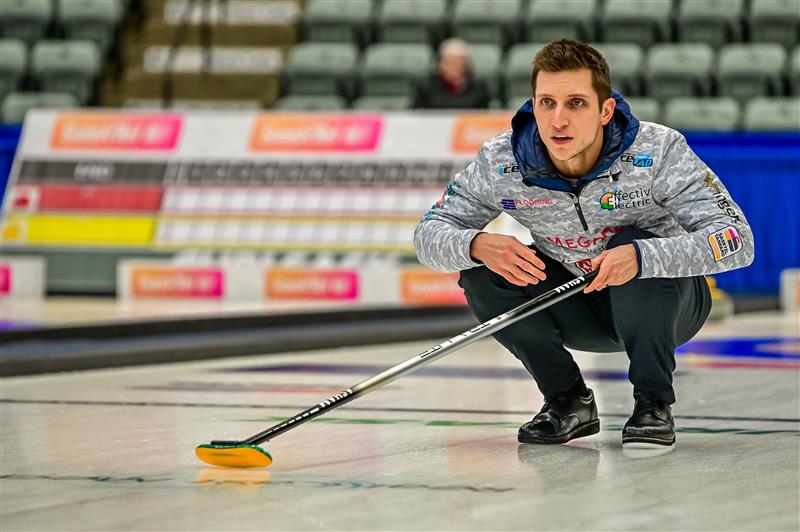
This is skip Kelly Knapp's second trip to the Brier having represented Saskatchewan at the 2024 Brier. Photo by Wanda Harron
Every curling team develops a personality over the course of a season. That steadiness, that refusal to crack under pressure, has become part of the team's identity. Brennen Jones describes the team as tight and competitive in equal measure.
"Kelly, Dustin, Brian and I have been together for quite some time, so it was important this year to find someone who shared a similar mindset and personality," he says. "We spend a lot of time together on and off the ice throughout the season, and having fun is a huge part of what makes us successful."
In the team's world, fun means relentless competition, card games in hotel rooms, strategy debates over meals, and a steady current of jokes that keep the mood light when stakes climb.
"We joke around a lot, play games, we're extremely competitive, and really prioritize team bonding and building," Jones says. "Our identity is being a tight-knit group that supports each other while enjoying the process. Having fun is the most important piece for us."
Kidby echoes that sentiment when asked about behind-the-scenes rituals that fans never see.
"Spending time together and enjoying each other's company is a big help to being grounded out on the ice and always having each other's backs," he says.
The foundation of that camaraderie runs deep. Twins Kelly and Trent have curled together since childhood, building a shorthand that can't be manufactured. A raised eyebrow, a half-smile, a quick nod in the hack, communication that predates provincial jackets and televised draws.
Representing Saskatchewan at the Brier is, as Jones puts it, "an incredible honour." Wearing provincial colours never loses its edge. But sharing a University of Regina bond makes this run different.
"It's pretty unique to be able to say that's [the team's shared alma mater] part of our team identity, not many teams can," Jones says. "Every single player, including our fifth Trent, falls into that category. It makes it really meaningful and something we're proud of."
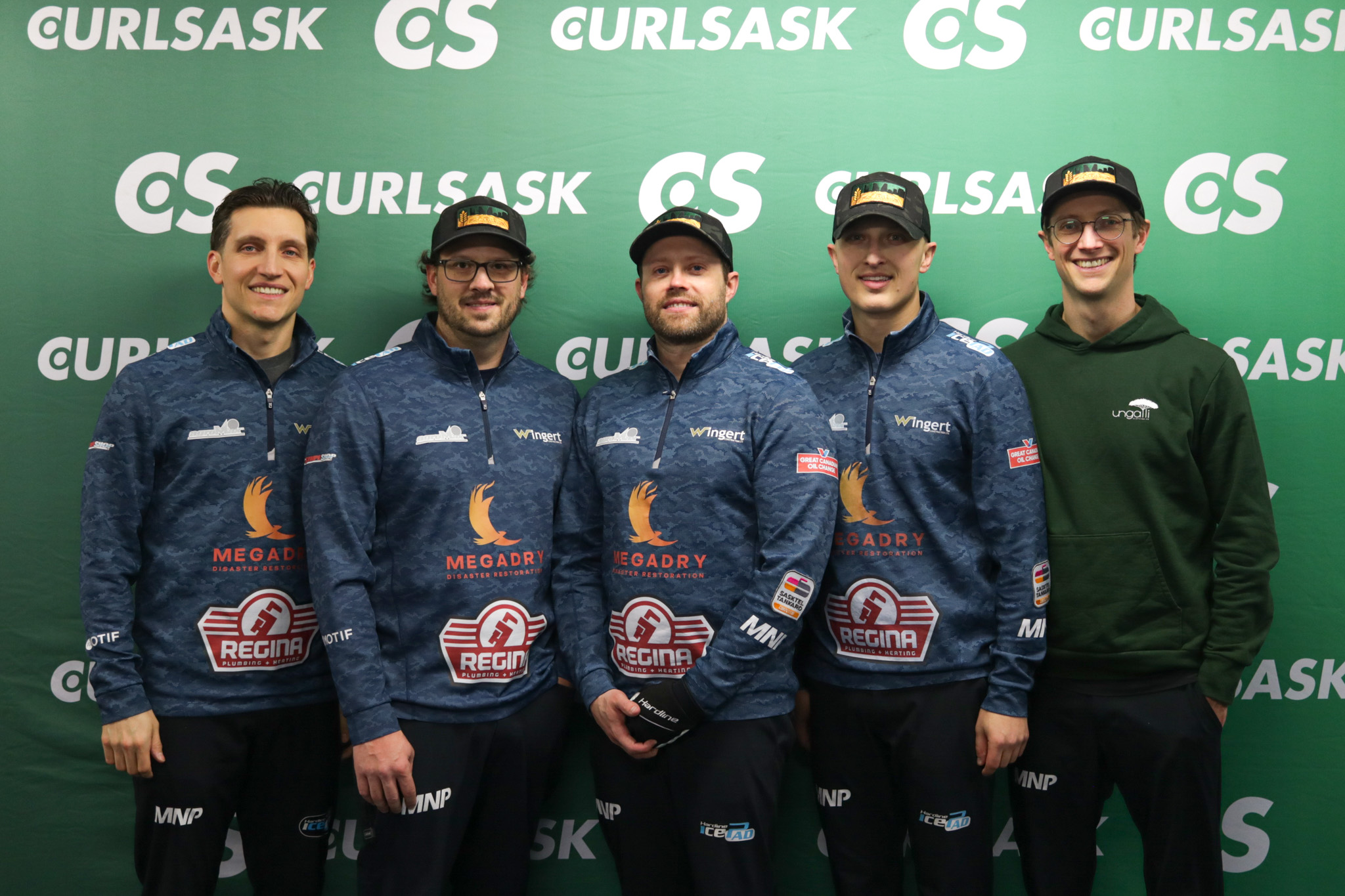
The Knapp rink bettered all the competition at the Sasktel Tankard in Melville in January. Their win earned them a trip to the Montana's Brier being held in St. John's Newfoundland beginning Februrary 27. Team members (left to right) Kelly Knapp, Brennen Jones, Dustin Kidby, Mat Ring, and Trent Knapp. Photo courtesy of CURLSASK
For Mat Ring, the University was more than a stop along the way. It was a launching pad.
"I would honestly say that my time at the U of R 100 per cent helped launch my professional and athletic careers," Ring says.
He points to mentor Alison Fisher, who supervised his first placement and opened doors, including a six-month opportunity at the 2016 World Women's Curling Championship, that helped him build professional connections and see the sport from a different vantage point.
On the ice, the university experience looked different then. Athletes pieced together their own teams and battled for the right to represent the school at Canada West playdowns.
"My very first year, we actually lost out to Brian's son's team in the U of R final," Ring recalls. "I was fortunate to go with them as a fifth and learn the ropes at that level. An amazing experience that helped launch that part of my curling career."
Kelly Knapp's path underscores a reality many student-athletes face - timing.
In a sport where athletes often peak later in life, he was able to prioritize education first, completing both bachelor's and master's degrees and stepping away from competitive curling to finish his physiotherapy program.
"I just had to find a balance between sport, family and work," he says. "I have an amazing support system so that makes it easier."
His advice to current University of Regina student-athletes is honest.
"It's difficult, but achievable," Knapp says. "If you are passionate about your sport and you have goals, I say go for it. But you do have to be conscious of your own priorities and what is being sacrificed."
Banner photo: Coach Brian McCusker (second from left) remains optimistic heading into the Brier. In his estimation, the team can definitely make the playoffs and at that point, he says, anything is possible. Photo courtesy of CURLSASK
[post_title] => Knapp rink on the button for another Brier appearance
[post_excerpt] =>
[post_status] => publish
[comment_status] => open
[ping_status] => open
[post_password] =>
[post_name] => team-knapp-brier
[to_ping] =>
[pinged] =>
[post_modified] => 2026-02-19 16:34:55
[post_modified_gmt] => 2026-02-19 22:34:55
[post_content_filtered] =>
[post_parent] => 0
[guid] => https://www.degreesmagazine.ca/?p=9955
[menu_order] => 0
[post_type] => post
[post_mime_type] =>
[comment_count] => 0
[filter] => raw
)