WP_Post Object
(
[ID] => 9241
[post_author] => 12
[post_date] => 2025-07-14 16:17:58
[post_date_gmt] => 2025-07-14 22:17:58
[post_content] =>
This wasn't brought on by some life crisis - not mid, late, or otherwise. It wasn't about mortality, regret, or checking off an item on a dusty old bucket list.
It was 4:30 a.m. and I had been stumbling through the coal-dark night for the better part of five hours. It would be another four hours until we would reach our much-anticipated destination - a weather-beaten sign, post-holed into the ice and volcanic rubble at 5,895 metres above sea level, at the top of the highest free-standing mountain in the world, the summit of Mount Kilimanjaro in Tanzania.
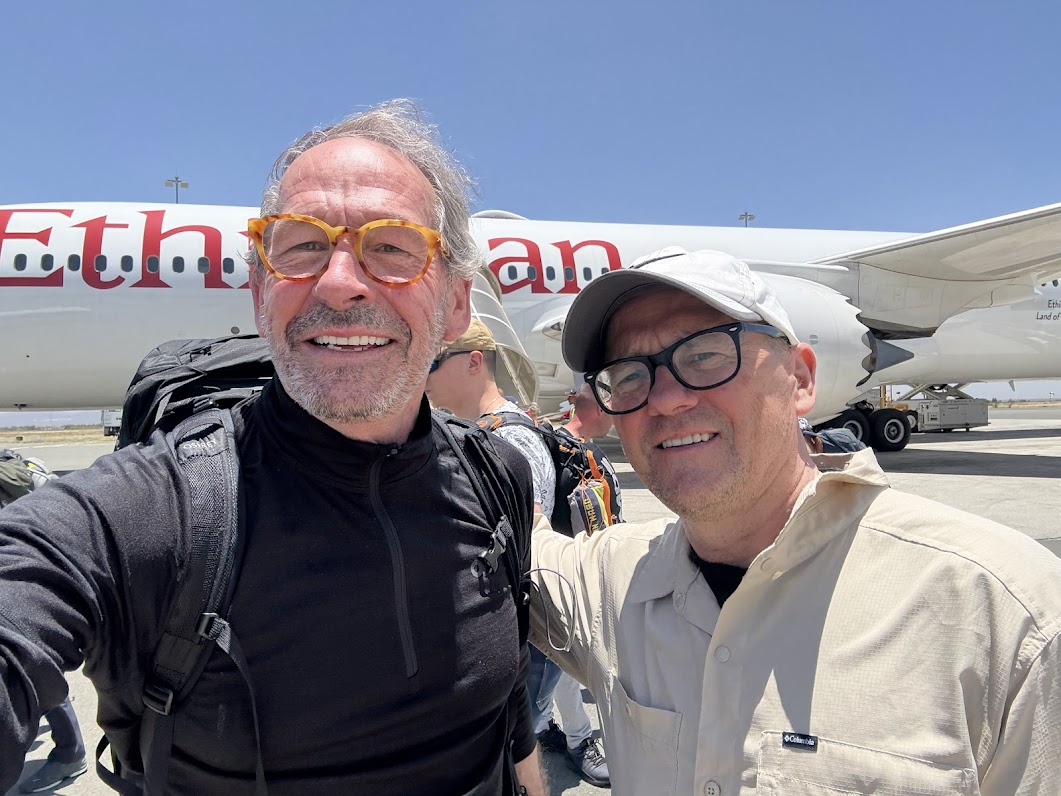
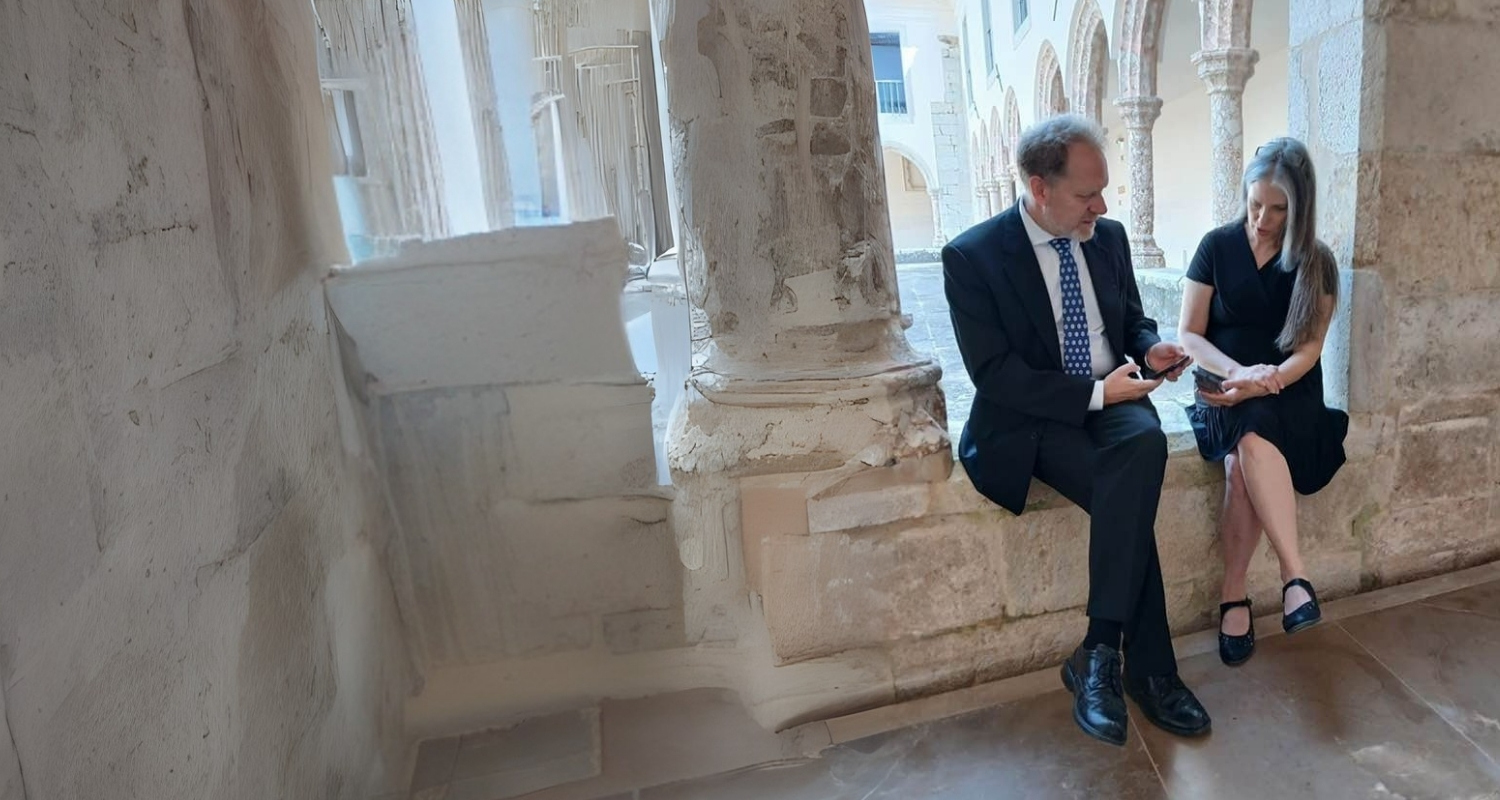
The author (left) and Marcel Asselin arrive at Kilimanjaro International Airport, three days before they begin their assult on Mount Kilimanjaro.
I've always been drawn to wild places. Family vacations were spent riding horseback throughout the eastern slopes of the Canadian Rockies. I canoed the Nahanni River that winds through the remote Northwest Territories wilderness. I hiked the rugged West Coast Trail. I've pitched tents in Saskatchewan's boreal forest and paddled the inlets and bays near Tofino B.C. in my cedar-strip kayak.
The day before I turned 60, I stood on the South Rim of the Grand Canyon and started the 10-kilometre descent down the South Kaibab Trail to the Colorado River. The next morning, I hiked up the 12-kilometre Bright Angel Trail in five and a half hours and celebrated with a double cheeseburger and a firm promise that I'd never do anything like that again.
Then Kilimanjaro set up camp in my brain.
So, Kilimanjaro, I resolved, would be my swan song. Not a pilgrimage, not a quest, but an exclamation mark. A walkabout to punctuate a lifetime of outdoor pursuits before arthritis sets in and excuses become easier than effort.
This grand undertaking started impulsively on February 29, 2024 - my 16th birthday thanks to the quirks of the Gregorian calendar. I dropped a down payment on a trek with a British outfit called Kandoo Adventures, which boasted a 97% success rate on its website which featured a lot of smiling hikers and not a single photo of a helicopter evacuating the weak and defeated.
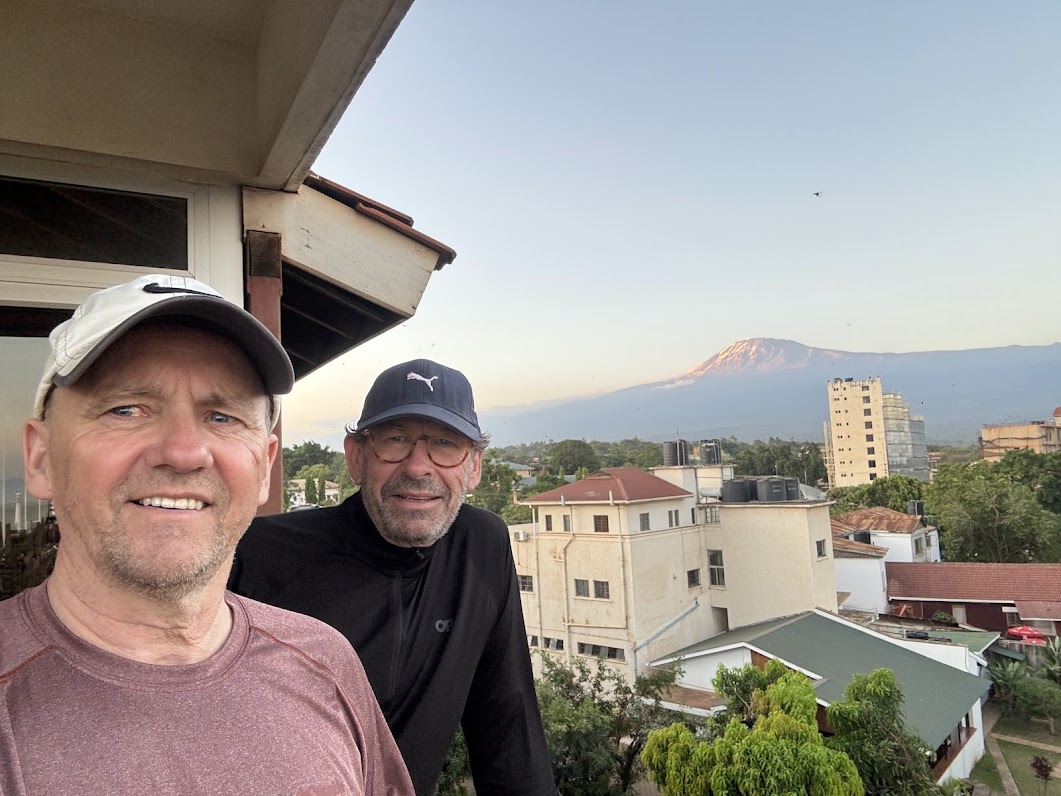
Mount Kilimanjaro looms over Moshi, Tanzania where Asselin and Campbell began their Tanzanian adventrure. Nine days after this photo was taken, the pair would be standing on the summit of the highest free-standing mountain in the world.
On that same day, I got my first tattoo - carpe diem - on my left bicep.
Seize the day indeed.
My obsessive research began. I read everything I could get my eyes on about Kili. Blogs, forums, and guidebooks. I watched scores of YouTube videos narrated by cheerful Australians and grim-faced Germans.
Kilimanjaro isn't a technical climb - there's no need for ropes, ice axes, or crampons on the mountain. But it is a trudge, a struggle, a grind. And then there's summit night.
What you need to succeed on Kilimanjaro is adequate fitness, a resolute mind, patience, and a willingness to suffer quietly. I read about 12-year-olds who summited. Octogenarians who crossed the mountain off their to-do lists. There was even a guy who carried a fridge strapped to his back to the top.
If they could do it, I figured I had a decent shot.
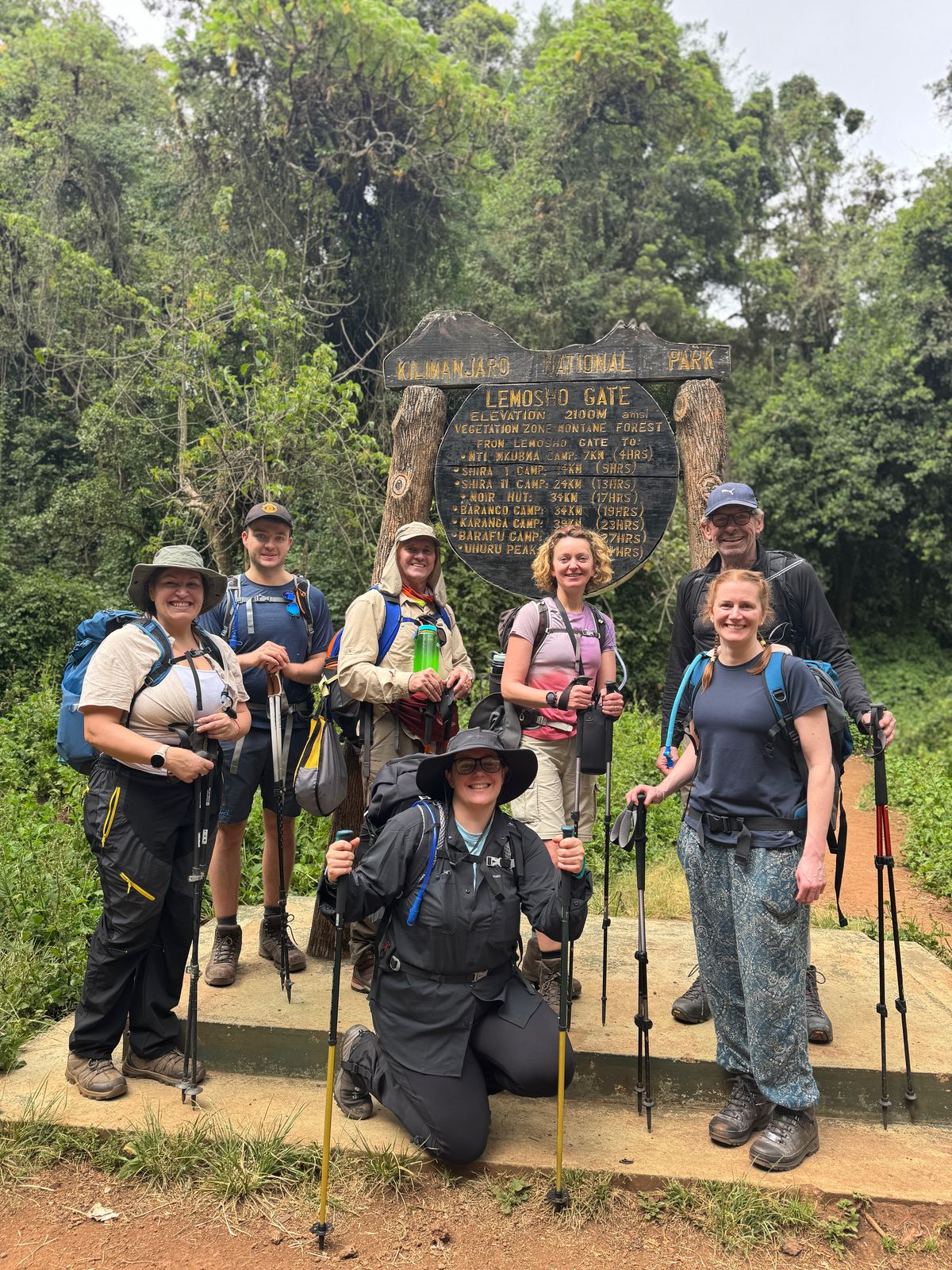
The seven trekkers of InZania, including Asselin and Campbell, at the Lemosho Gate, the start of their Kilimanjaro odyessy.
There are eight routes up Kilimanjaro that take anywhere from five to eleven days to complete. Because proper acclimatization is critical to success, I chose the Lemosho eight-day trek. The route is recognized for its beauty, diverse landscapes, exceptional acclimatization, and high success rate.
Beginning on Kilimanjaro's western flank, the Lemosho route ascends through four distinct climate zones: rainforest, moorland, alpine desert, and finally, the arctic summit zone. Trekkers navigate the Shira Plateau and climb the dramatic Barranco Wall, two of the route's topographical highlights.
[video src="https://www.degreesmagazine.ca/wp-content/uploads/2025/06/IMG_0569-1.mp4" mp4="https://www.degreesmagazine.ca/wp-content/uploads/2025/06/IMG_0569-1.mp4" poster="" ][/video]
First day hiking through Kilimanjaro's rainforest.
In anticipation of the trek, I ramped up my training, bought additional gear (that I may or may not need), and continued my relentless research.
But one troubling detail kept nagging at my game plan - I didn't want to do this one solo.
In 2019, I had attempted the 22-km Berg Lake Trail in B.C. alone. Eleven kilometres in, rain soaked, and in a mood most foul, I turned around and walked out. It's a decision I came to regret.
[video src="https://www.degreesmagazine.ca/wp-content/uploads/2025/06/IMG_0618-1.mp4" mp4="https://www.degreesmagazine.ca/wp-content/uploads/2025/06/IMG_0618-1.mp4" poster="" ][/video]
Approaching the moorlands, the second of Kilimanjaro's climate zones.
I did not want to tap out on Kilimanjaro. But who could I turn to for encouragement and companionship on such an ambitious journey with so little notice?
Then it struck me. Marcel.
Marcel Asselin BEd'86 and I met in 1980, when we played on the same U of R intramural hockey team. He was a talented, intense, two-way player whose deft scoring made up for the mediocre goaltending that I brought to the rink.

Marcel is from Ste-Marie Beauce, Quebec, some 60 kilometres southeast of Quebec City. He enrolled in the English as a Second Language program at the University to expand his horizons and force himself outside of his comfort zone. When he arrived on the prairies, he spoke little English. But he brought with him a U-Haul trailer worth of dogged determination and stick-to-itiveness that served him well living in a new city and learning a new language. That perseverance would prove equally valuable 45 years later when an old pal invited him on the adventure of a lifetime.
[video src="https://www.degreesmagazine.ca/wp-content/uploads/2025/06/IMG_0728-1.mp4" mp4="https://www.degreesmagazine.ca/wp-content/uploads/2025/06/IMG_0728-1.mp4" poster="" ][/video]
The members of InZania hike the alpine desert, closing in on their goal of summiting the roof of Africa.
Marcel and I had drifted in and out of each other's lives after we graduated from the U of R. He earned an education degree and went on to a long teaching career while I embarked on short-lived career in film production before returning to the University to complete a journalism degree.
Still, we managed to stay in touch, whether by design or chance.
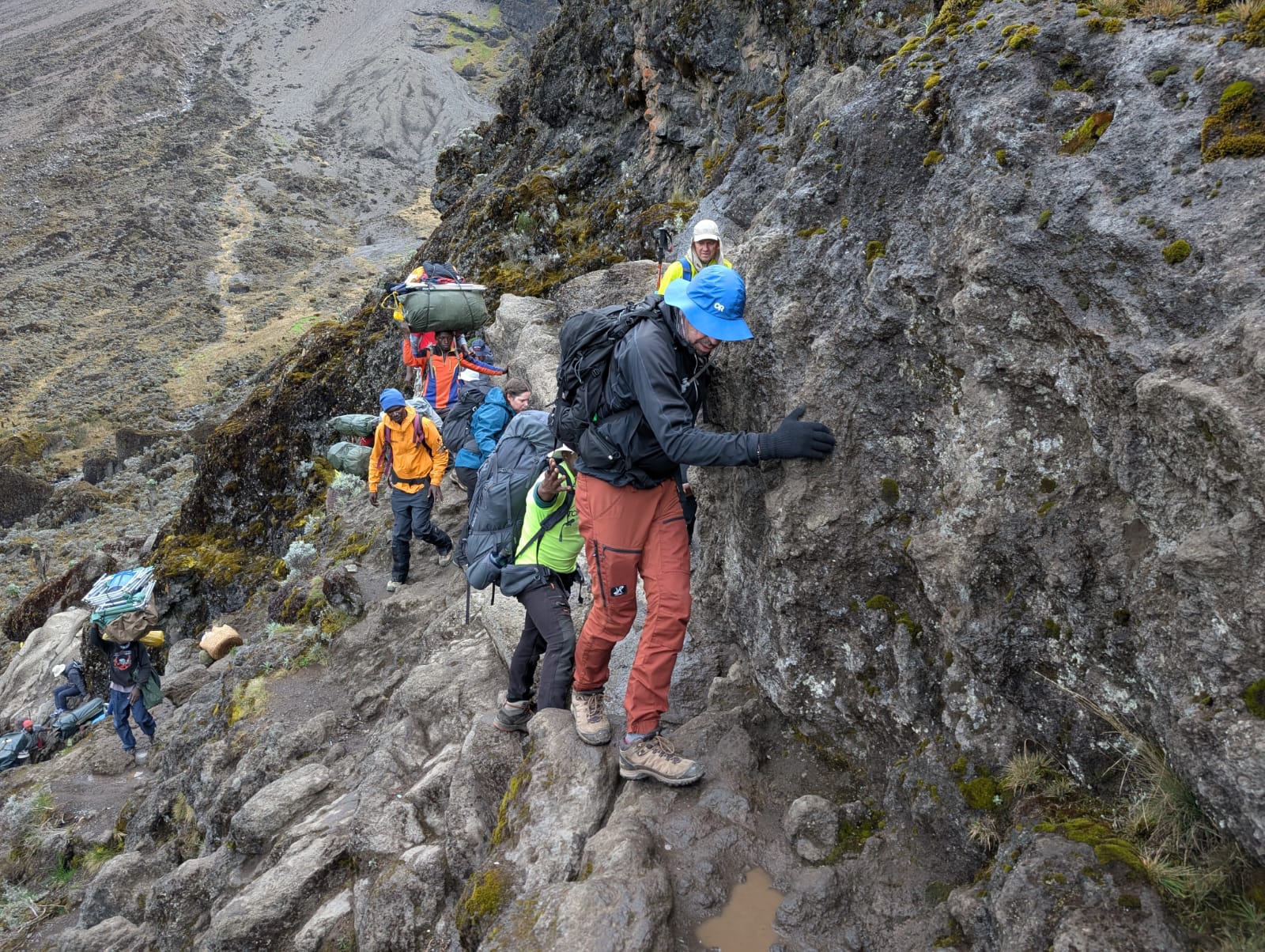
The author navigates the Barranco Wall, or Death Wall as it's sometimes known. Hikers on the Lemosho Route scramble up the 250-metre wall on day five of an eight day trek.
We hiked the West Coast Trail in the early '90s. Cycled B.C.'s Gulf Islands. I photographed his wedding in 1997. We played together in the over 35 division in the Adult Safe hockey league - which ironically, was neither safe nor particularly adult.
Years passed. Our kids grew. We ran into each other now and then - at our daughters' volleyball tournaments and in grocery stores. Then, about four years ago, we reconnected meaningfully and caught up on the time that had slipped between us. Some friendships are like good whiskey and cast-iron skillets - they better with age.
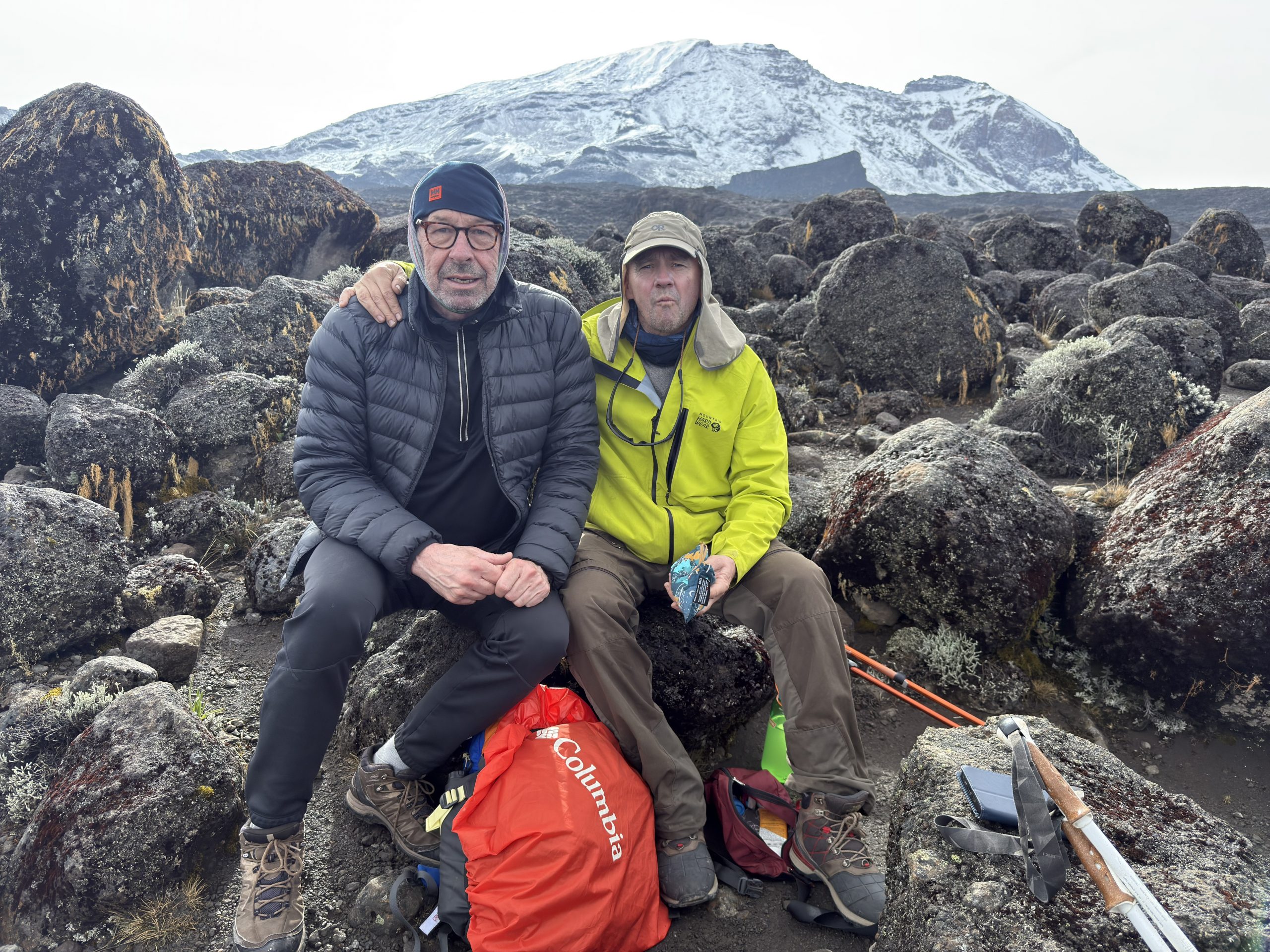
Despite having drifted in and out ot each others lives for some 45 years, Campbell and Asselin share a special bond through their outdoor adventures.
Now, with both of us in the over 60 division, it was time for one last adventure.
I texted him. "Hey - want to climb Kilimanjaro?"
"Let's talk," he replied.
I called him and laid out the details I had already set in motion. He said he'd decide within a week.
Ten minutes later he texted: "I'm in."
Neither of us could know what fate had in store for our odyssey. Success or failure on Kilimanjaro is arbitrary. Whatever the mountain had in mind for us, we'd face it together.
And so, on March 8, 2025, with five other trekkers, Marcel and I began the eight-day ascent of the roof of Africa.
Our group - nicknamed InZania - became our family for just over a week. Hiking an average of five to seven hours-a-day became the routine - our Groundhog Day.
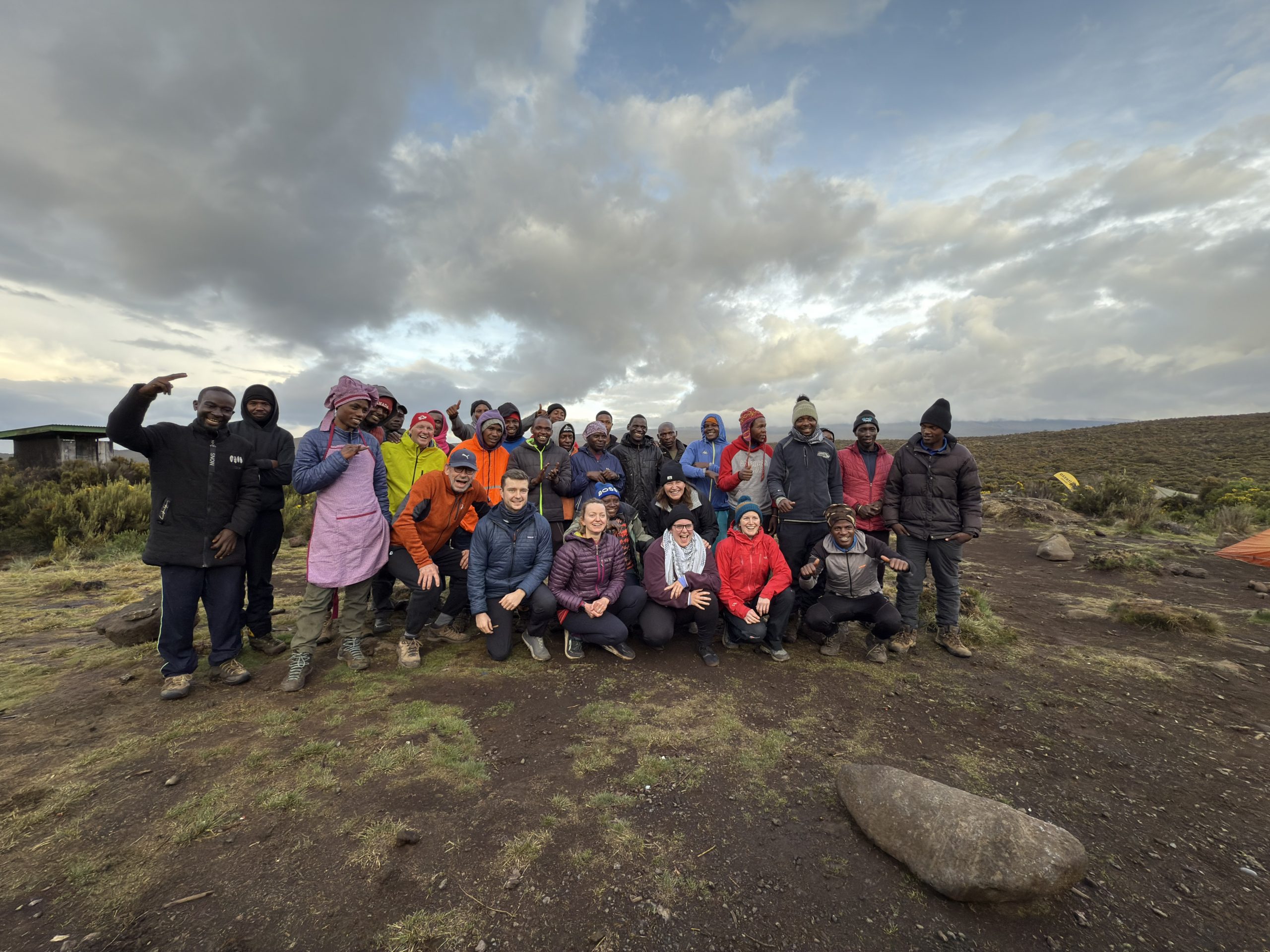
The entire InZania team consisted of 7 clients, 3 guides, a cook, maître d', and 23 porters.
As the days passed, the landscape changed. Rainforest gave way to moorland, then to alpine desert and finally to the arctic summit zone. We walked among towering Dendroseneccio kilimanjari, the prehistoric-looking, pineapple-like plants that only grow on Kilimanjaro. We climbed the dreaded Barranco Wall - which, despite my vivid nightmares, was not the death-defying scramble I'd imagined.
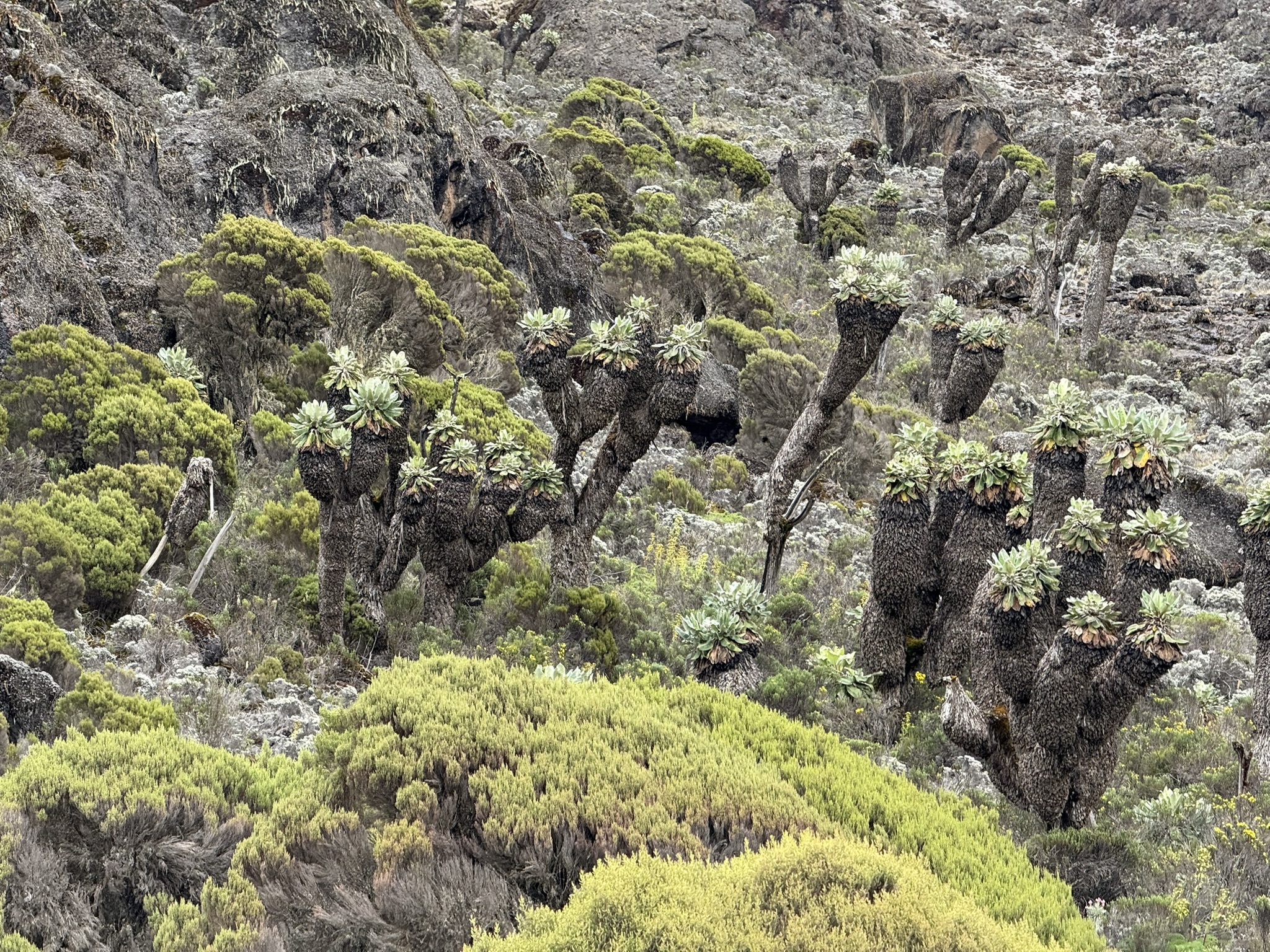
The strange looking Dendroseneccio kilimanjari only grow on Kilimanjaro.
The daily rhythm was simple: wake, eat, hike, rest, repeat. Marcel moved with quiet confidence, rarely showing strain, always entertaining the troop with his tomfoolery. I followed his pace, partly for morale, partly because he seemed the sole trekker among us who truly embraced the Swahili mantra pole, pole - slowly, slowly - the key to success.
Somewhere, in all that trekking, something quietly wonderful happened.
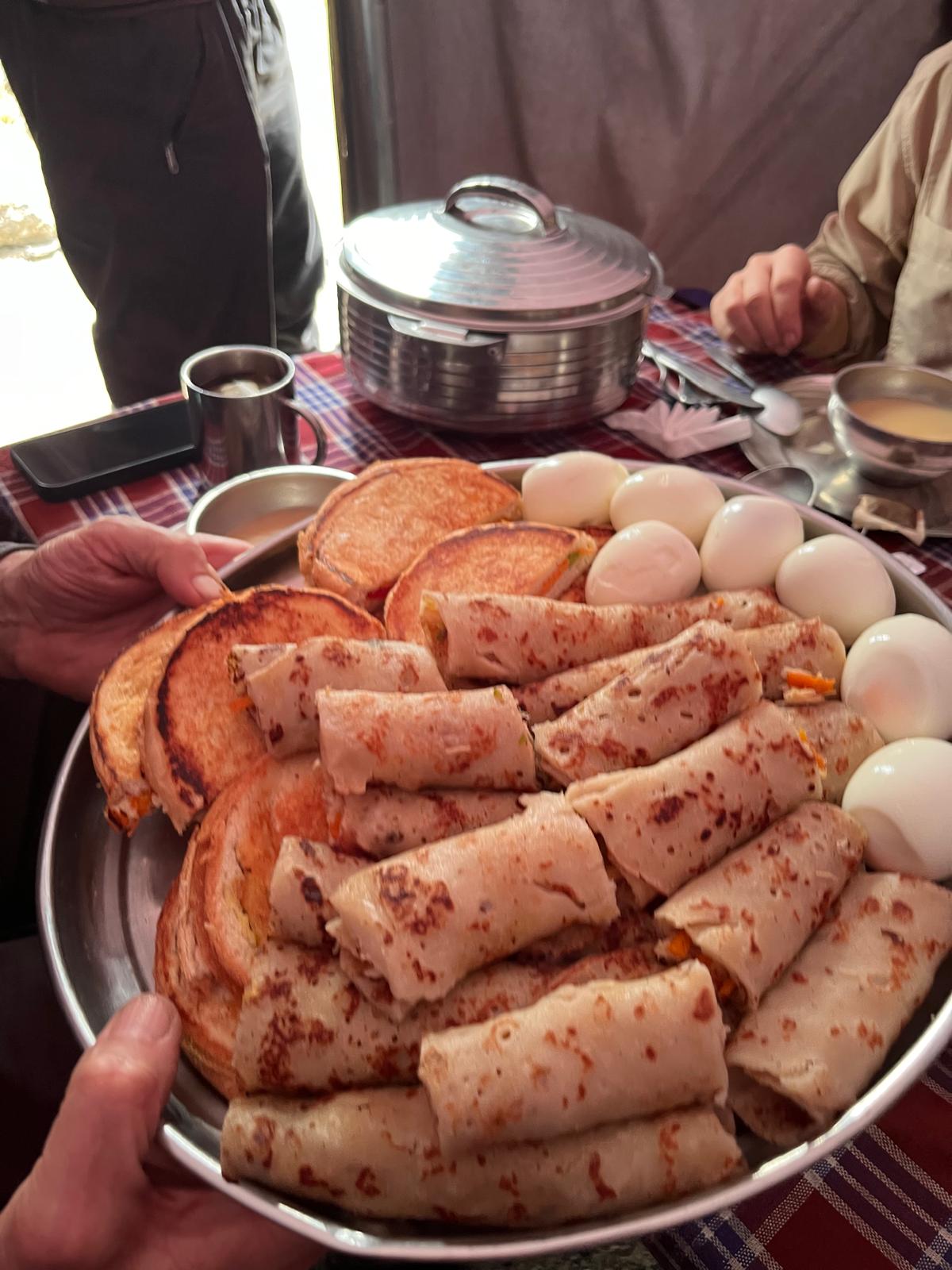
The meals on the trek were outstanding and included grilled cheese sandwiches, crepes, and boiled eggs, at 3,900 metres no less.
Marcel and I found our rhythm. We fell into step. We talked. About our kids, our work, our hopes, our aches, our lives. We shared trail snacks and offered the kind of encouragement that only long-time friends can deliver - sincere but dripping in sarcasm.
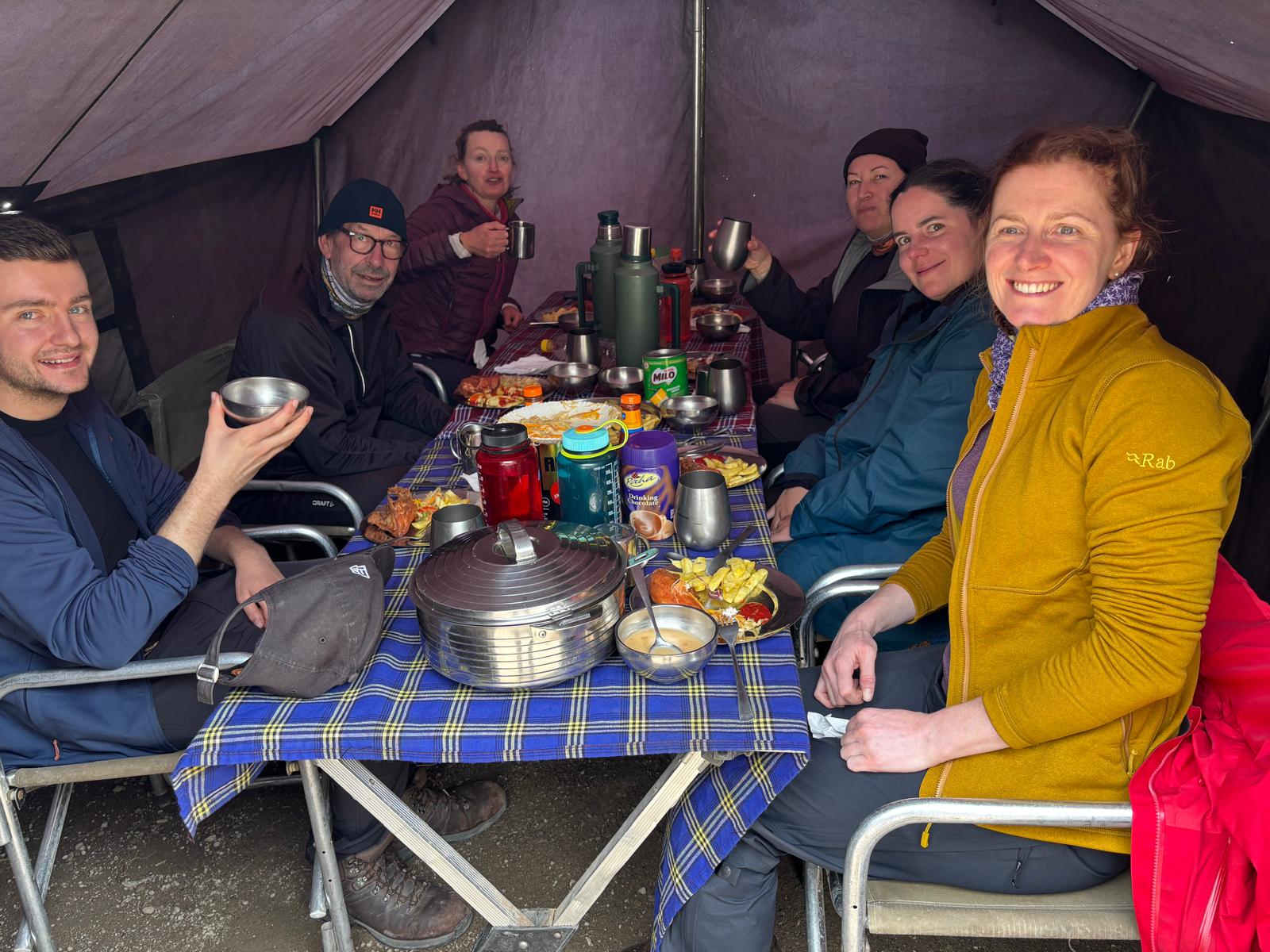
At the end of a difficult day of hiking, the group could always rely on a hearty meal and some welcome social time in the mess tent.
Though the days were excruciatingly demanding, we were not roughing it - au contraire - it was the most luxurious camping I've ever experienced.
We had a cook. A dining tent. Real chairs. We ate spaghetti bolognese, pork kabobs, and herb-and-lemon chicken. Each meal began with soup and ended with sweets, including freshly baked cake, on two occasions. We were served eggs - real eggs - at 3,900 metres. We had our own toilet, a little dicey by modern standards, but a welcome convenience on the mountain, nonetheless.
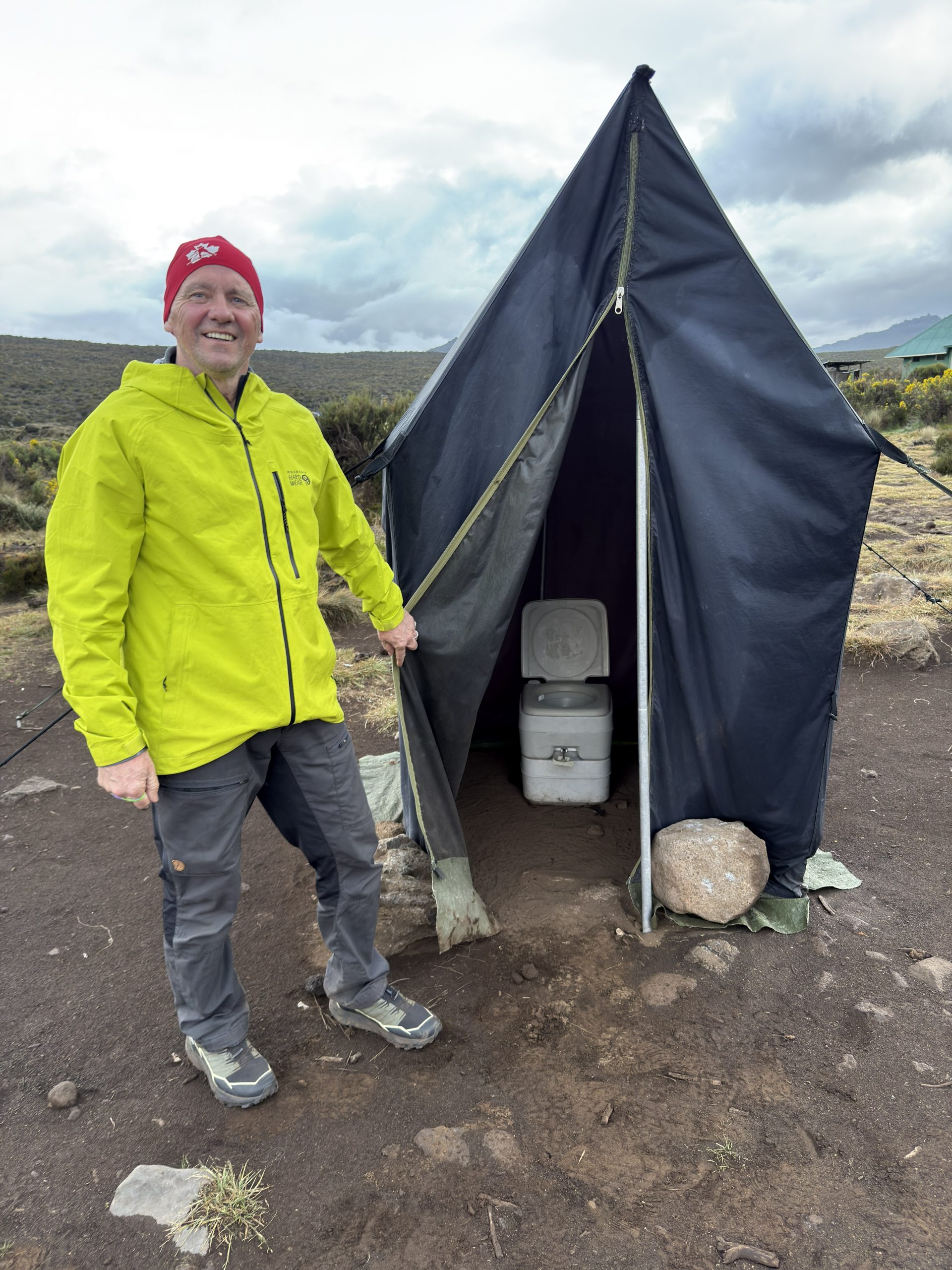
Asselin pulls back the cover on the camp toilet, affectionately known as the Wizard of Pooz.
These comforts of home were made possible by the real heroes of Kilimanjaro - our Tanzanian support team. By any measure, they were the ones who truly bore the weight of the mountain on their shoulders. The group consisted of 3 guides, 23 porters, a cook, and a maître d'. Yes, maître d'.
The porters carry the lion's share of everything that goes up the mountain: tents, food, water, and pots and pans. They also lug clients' duffel bags, weighing up to 15 kgs. Many porters carry these extra loads on their head, in addition to toting fully loaded backpacks. Countless sport well-worn sneakers instead of sturdy hiking boots. Without them, climbing Kilimanjaro is impossible.
[video src="https://www.degreesmagazine.ca/wp-content/uploads/2025/06/IMG_0677-1.mp4" mp4="https://www.degreesmagazine.ca/wp-content/uploads/2025/06/IMG_0677-1.mp4" poster="" ][/video]
InZania's lead guide, Raymond, rests as porters make their way up the mountain.
With tips that average $10 USD a day, you would be hard pressed to find better, more affordable help. Still, it's a good wage by Tanzanian standards. With thousands of climbers attempting Kilimanjaro every year, the jobs are a crucial part of Tanzania's tourism economy, supporting thousands of families. Their gruelling labour allows those of us who pay for the pain and suffering to focus on the physical challenge - long, difficult days of hiking.
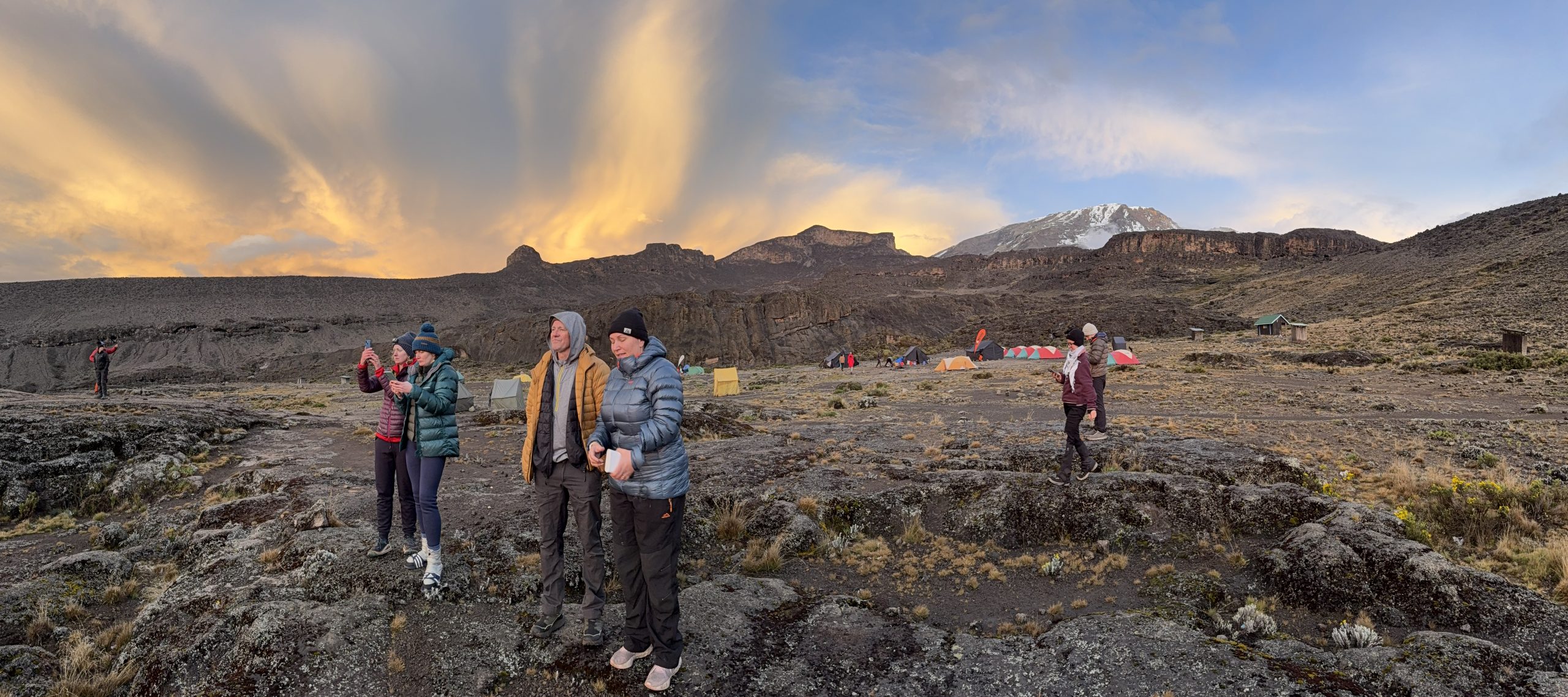
Members of InZania gather for photos of a glorious sunset while the summit of Kilimanjaro can be seen in the background.
The porters snake across the mountain with grace, pace, and good humour. On the trail, never-ending refrains of "hakuna matata" (no worries) and "jambo, jambo" (hello) fill the air. They were always there to encourage you, especially when you need it most.
You need it most on summit night.
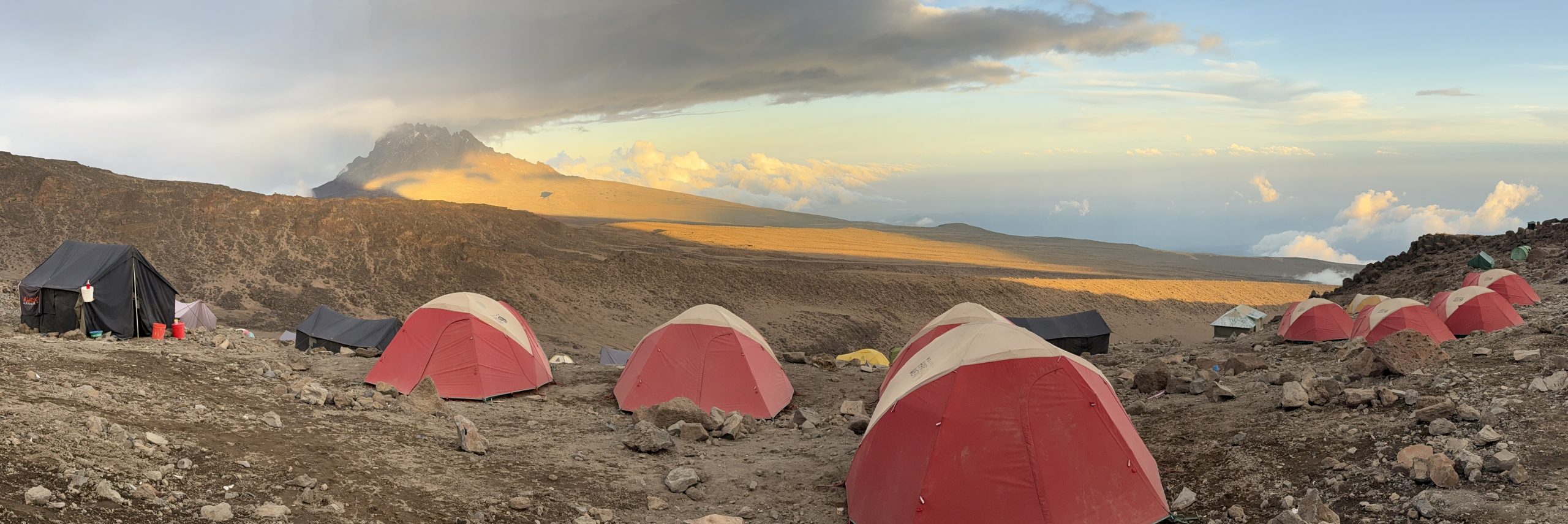
The Lemosho route's high camp perched at some 4,700 metres, 1,200 metres below the summit.
On that joyous evening, you have dinner about 5 p.m., then crawl into your sleeping bag to try to get some sleep before an 11 p.m. wake up call. After attempting a light meal, you pack and layer up, and, about midnight, start climbing into the Kilimanjaroan night.
The eight and a half hours of lumbering up the mountain were the most physically taxing of my life. My only thoughts were to put one foot in front of the other, again and again and again.
[video src="https://www.degreesmagazine.ca/wp-content/uploads/2025/06/854bc6cc-a687-45cd-9e55-c4984df3d8f0-1-1.mp4" mp4="https://www.degreesmagazine.ca/wp-content/uploads/2025/06/854bc6cc-a687-45cd-9e55-c4984df3d8f0-1-1.mp4" poster="" ][/video]
Hikers are shilouetted by the rising sun on summit day, March 14, 2025 on Kilimanjaro's eastern flank.
It's a strange thing, climbing towards a goal you can't see. You move slowly. You don't speak because breath is precious. You don't look up because the top is a lie. You just push forward.
Of all those who stand on Kilimanjaro's stony crown, a mere one per cent are aged 65, as are Marcel and myself. For six and a half days, like two senior citizens possessed, we willed ourselves upward, until, at 8:20 a.m., the summit was ours.
I had imagined tears and a euphoric, cinematic release. I pictured Marcel and I sobbing, locked in a bro-embrace, manically laughing in oxygen-deprived triumph.
[video src="https://www.degreesmagazine.ca/wp-content/uploads/2025/06/ea9ab484-2e0e-4622-b47e-c0934aae9ae7-1.mp4" mp4="https://www.degreesmagazine.ca/wp-content/uploads/2025/06/ea9ab484-2e0e-4622-b47e-c0934aae9ae7-1.mp4" poster="" ][/video]
Asselin and Campbell make the last push for the summit with other members of InZania.
But there was no rush of emotion. No epiphany. No existential clarity. No fireworks. No symphonic crescendo. Just that weathered sign and the thin, cold air.
We took a few photos and then we turned around and headed back down.
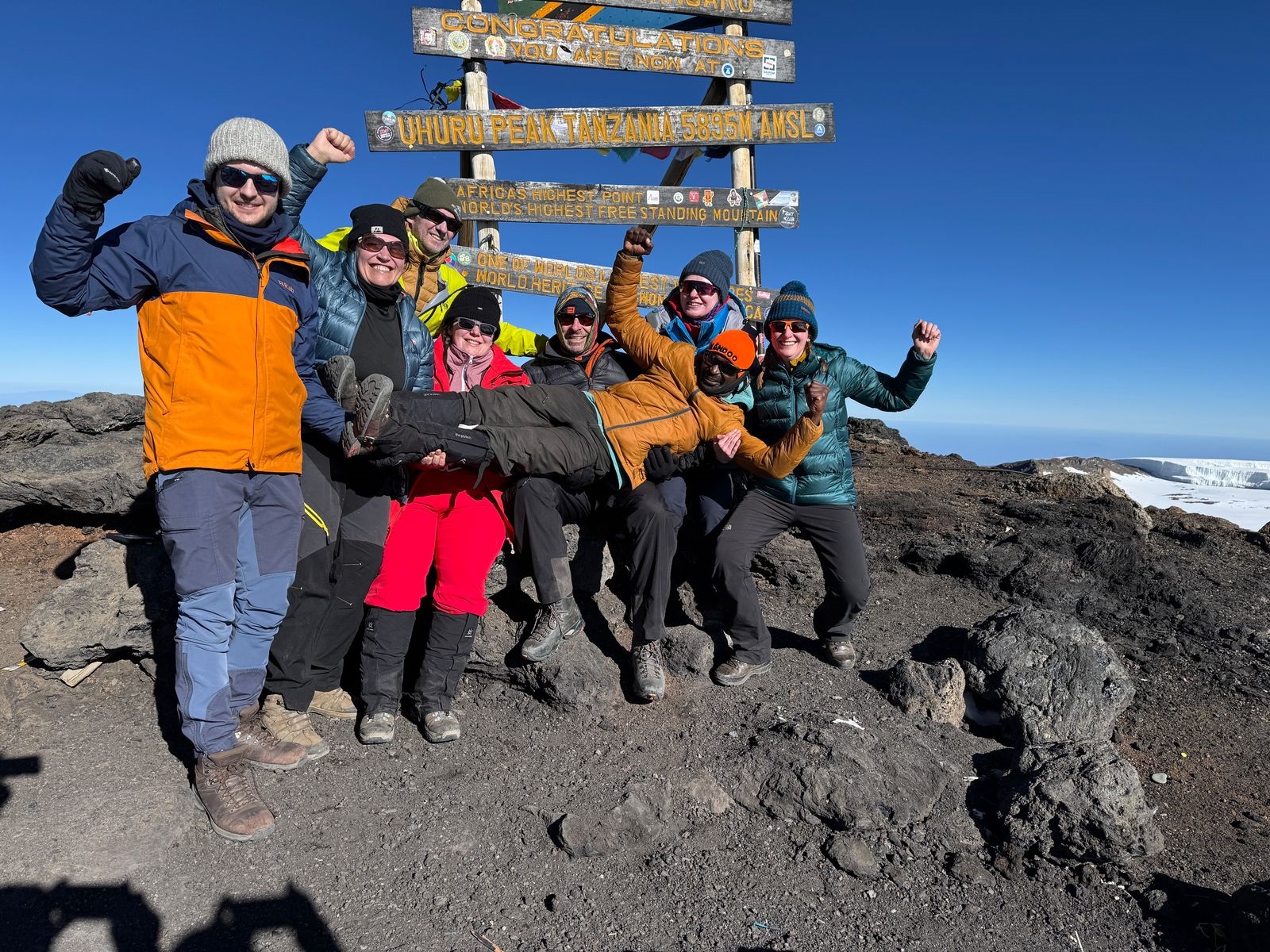
All seven members of InZania celebrate at Kilimanjaro's summit while Raymond, the group's lead guide, assumes a position of honour.
That was that.
So what was the point of all this? Was it life altering?
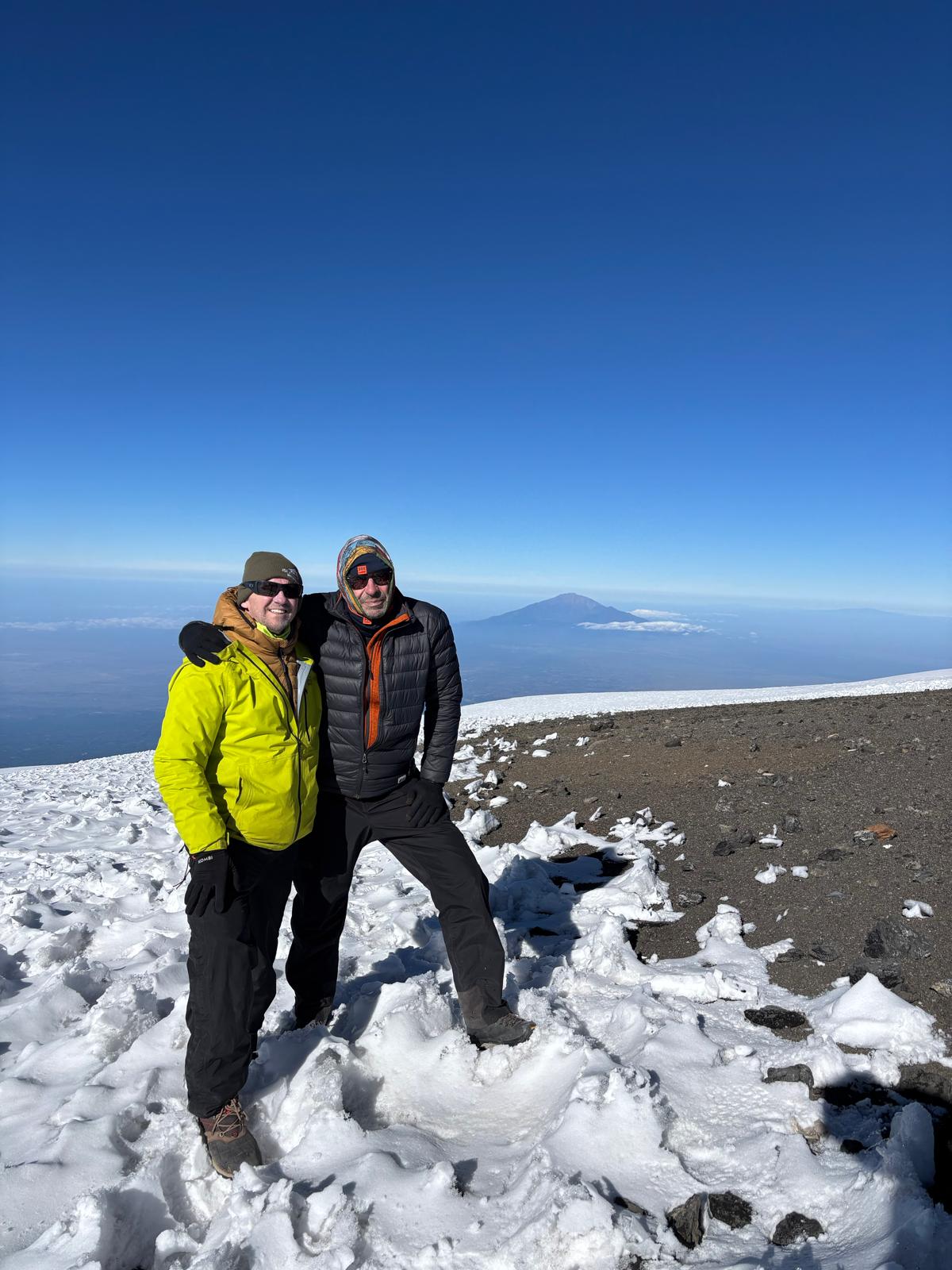
Asselin and Campbell pose for a photo near the summit of Kilimanjaro. Mount Meru, another dormant volcano, can be seen in the distance.
No, not in any grand, spiritual way. The summit didn't reveal hidden truths or erase my idiosyncrasies. The mountain didn't whisper to me or answer any of life's secrets. But it confirmed what I already suspected: that effort matters, that friendships deepen in shared silence, that it's better not to wait on things.
It's easy to mythologize, to make things bigger than they are. The summit isn't the point. The point is the journey. The struggle shared with others. The laughter and tears. The victories, together.
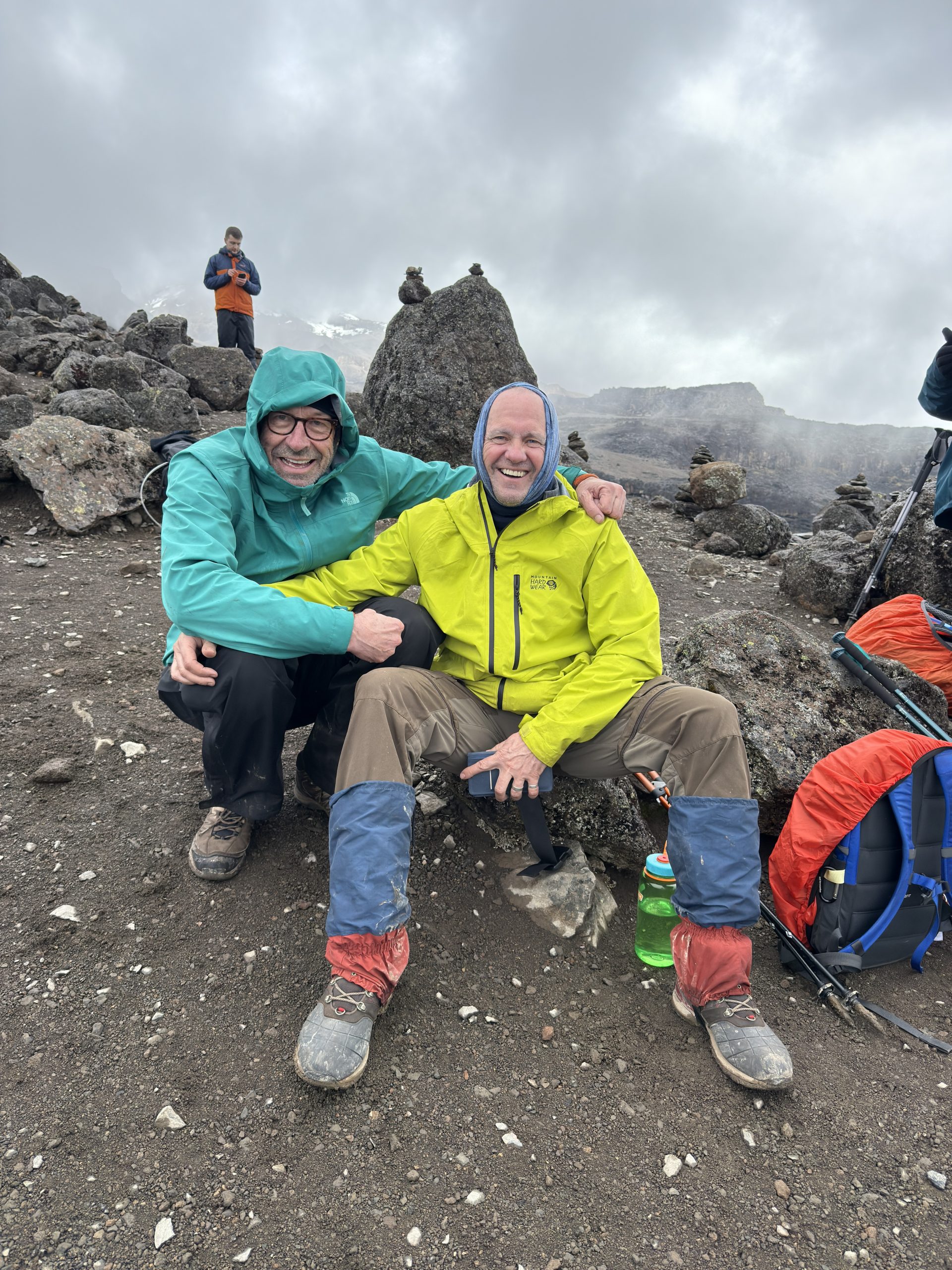
Campbell and Asselin share a laugh during the last days of their Kilimanjaro climb in March.
Mountains don't change you. They just give you a better vantage point to see who you already are.
Standing on the summit, I didn't feel heroic. I felt small and tired. Old and grateful. And alive. I thought of my family, my friends, my thighs.
I thought how lucky I was to have a friend like Marcel - and how rare it is, at any age, to move through such intensity with someone who knows of all about your worst and walks beside you anyway.
The sign at the top of Kilimanjaro reads: Congratulations. You are now at Uhuru Peak, Tanzania, 5,895 M.
I think what it really says is this: You are here. You climbed. You endured. You succeeded. You remembered what it feels like to live.
Mountains make poor therapists. They don't listen. They don't advise. They don't heal. But they're excellent mirrors. They reflect on those things you bring to life's dance: your baggage, your ego, your regrets, your aspirations.
Then they hand it all back to you in a mixing bowl.
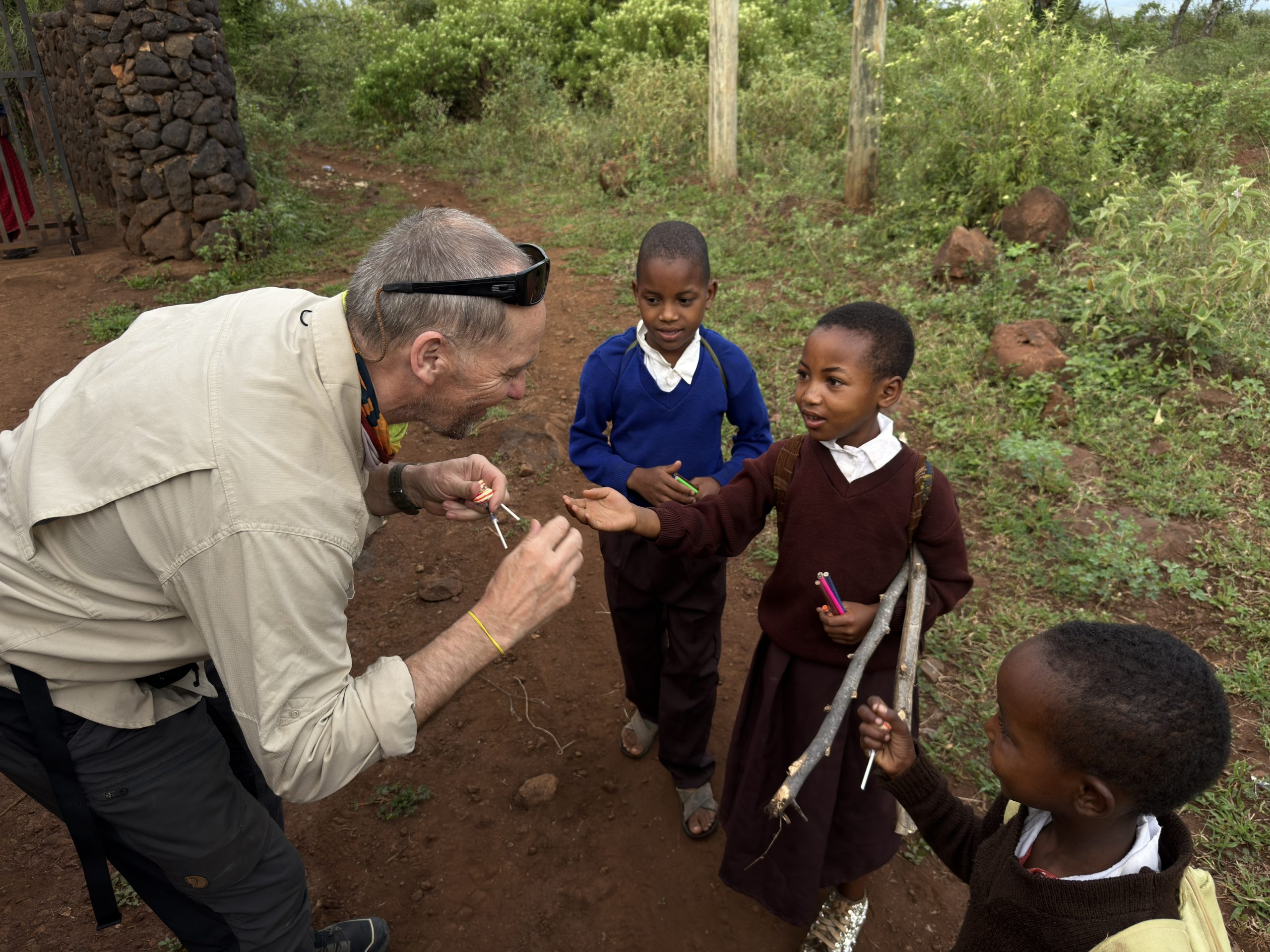
Asselin hands out treats and school supplies during his visit to Tanzania to climb Mount Kilimanjaro.
I returned home with a few simple truths.
That shared hardship nurtures connection. That altitude is no match for laughter. That you're never too old to do something foolish and challenging with a friend.
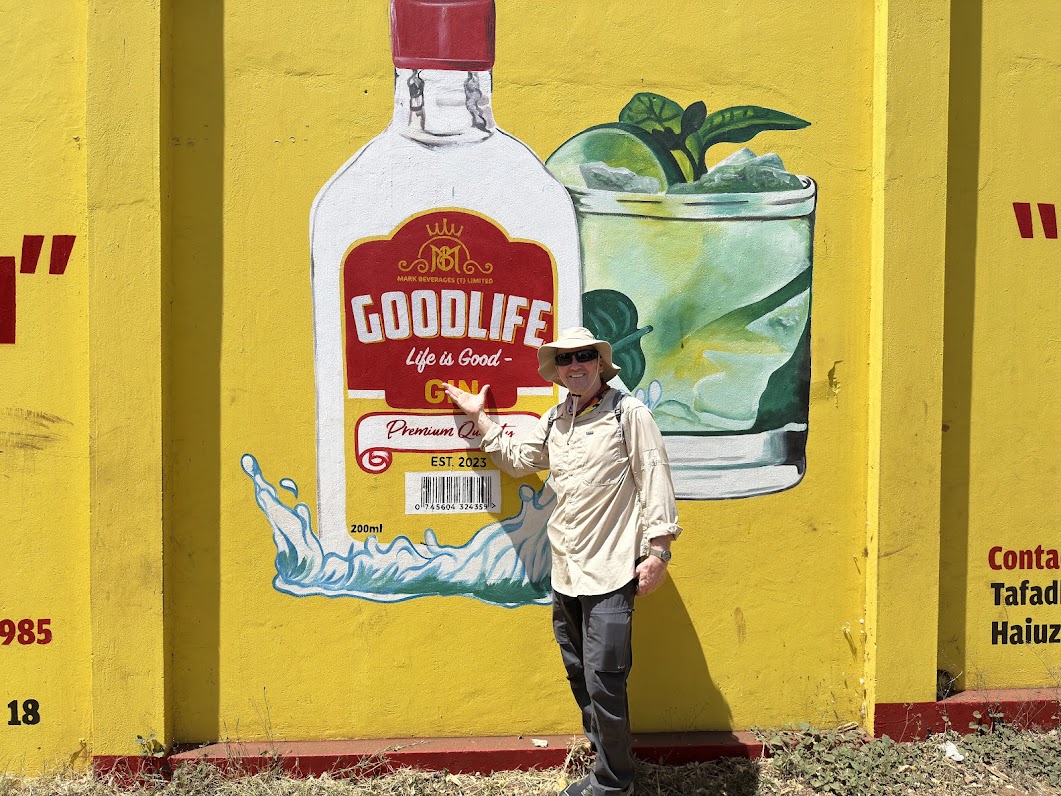
In an art imitating life moment, Asselin and Campbell adopted the motto "Life is good," for their climb. The phrase came from a Tanzanizn gin ad the pair saw before starting their climb.
Maybe carpe diem isn't about seizing anything. Maybe it's just about showing up. About saying yes. About lacing up your boots at midnight, turning on your headlamp, and plodding upward with a friend who's been closer to you than you know for 45 years.
Marcel and I recently got together for a few beers and some gloriously exaggerated recollections of our Kilimanjaro climb. Then, between sips of India Pale Ale, he dropped it on me.
"You want to trek to Everest Base Camp with me next year? I couldn't imagine doing it with anyone but you."
[post_title] => Seize the day
[post_excerpt] =>
[post_status] => publish
[comment_status] => open
[ping_status] => open
[post_password] =>
[post_name] => seize-the-day
[to_ping] =>
[pinged] =>
[post_modified] => 2025-07-31 09:58:47
[post_modified_gmt] => 2025-07-31 15:58:47
[post_content_filtered] =>
[post_parent] => 0
[guid] => https://www.degreesmagazine.ca/?p=9241
[menu_order] => 0
[post_type] => post
[post_mime_type] =>
[comment_count] => 0
[filter] => raw
)
WP_Post Object
(
[ID] => 9649
[post_author] => 20
[post_date] => 2025-11-19 16:25:13
[post_date_gmt] => 2025-11-19 22:25:13
[post_content] =>
This past summer, Brenda Reynolds Cert. Indian Social Work '86, BISW '87 was awarded the United Nations Nelson Rolihlahla Mandela Prize at UN headquarters in New York. Awarded every five years since 2015, the prize is given to a female and male laureate for their services to humanity, and who exemplify Mandela's commitment to reconciliation and social transformation. A selection committee representing five member nations-South Africa, Bahrain, Poland, Egypt, Saint Kitts and Nevis and Finland-received hundreds of nominations from 66 member states.
"It's the biggest compliment I have ever received," Reynolds says. "I have admired Nelson Mandela's work and what he did for his country. There are so many parallels, and to hear from the committee members that my nomination consistently made it through the decision-making process, was absolutely heart-warming.
Reynolds is the first Canadian and the first Indigenous person to receive the Prize, awarded to her for her development of the Indian Residential School Health Support Programme in 2006 and for her work with Canada's Truth and Reconciliation Commission.
Advocate in the making
Reynolds grew up on her grandparents' farm on Fishing Lake First Nation. She attended school in Wadena, fifteen minutes away. She remembers the buses that came in late summer each year to pick up children from Fishing Lake and how the community went into mourning afterward. One of only a few Indigenous kids at her school, Reynolds advocated for an after-school sports program in Wadena for kids from the reserve and was elected to student council in high school.
"I remember presenting in Grade 10 social studies about where I lived. I described the farm, the chickens and the big garden, similar to what people had in Wadena. The teacher said, 'Brenda, that isn't true'. I said, 'What do you mean that isn't true? The cows are the same cows. Our wheat on the reserve is no different than the wheat in the grainfields I see going home on the bus.' She goes, 'But you live on a reserve.' That was when I started learning about how differently Indigenous people are treated by non-Indigenous people."
It wasn't until Reynolds was a young social worker in Saskatoon, running a play-therapy after-school program at an inner-city school, that she learned about residential schools. "Every single child in my after-school program was living with an Indian Residential School Survivor," Reynolds says. "That was the first time I knew about them."
Reynolds negotiated a contract to provide counselling at Gordon's Residential School, where children from Saskatchewan, Alberta, and Manitoba attended. Across Canada, 150,000 children attended residential schools and many did not return home.
"I never attended residential school, so it was a real emotional awakening," she says.
At Gordon's, the students' shirt collars were numbered, the food was processed and within Reynolds' first and only year of work at the school, in 1988, 17 young women shared with her their experiences of abuse at the hands of a staff member. "Gordon's was the worst residential school in Canada in terms of abuse," Reynolds says.
After moving to Alberta, Reynolds worked with various levels of government before starting her own consulting service in mental health. She was asked to develop a health support program as part of the Indian Residential Settlement Agreement of 2006, which addressed the harms of residential school, and to this day, is Canada's largest class-action lawsuit settlement.
"Because we were talking about 150 years of trauma at the time, we couldn't rely on a conventional, Western model of health support, "Reynolds says. "We had to do things differently and to support the workers who would experience vicarious trauma exposure."
Reynolds says there wasn't a model to follow, so she based the program as best she could in healthy ways of dealing with trauma. "I knew that we had to include cultural interventions because in our Indigenous ways, we do have ways of managing mental health. We have the same principles as the Western way, but they are more congruent to the culture."
The health support program is funded to this day and includes cultural and emotional supports, mental health counselling and transportation for residential school survivors and their family members.
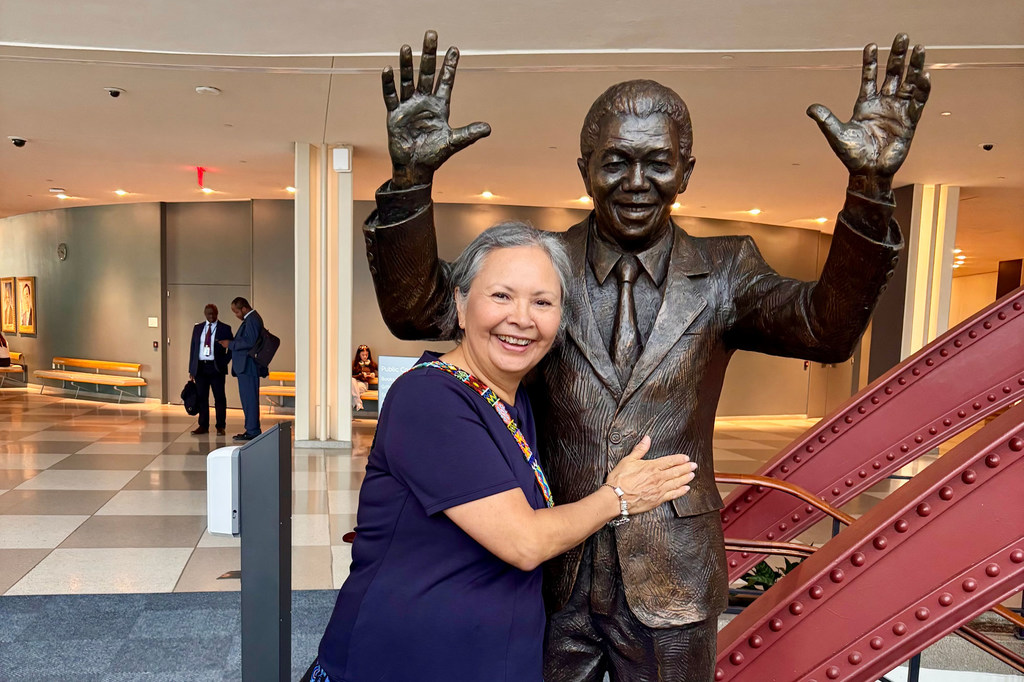
Brenda Reynolds Cert. Indian Social Work '86, BISW '87, recipient of the 2025 United Nations Nelson Rolihlahla Mandela Prize, poses with a statue of the late South African President at UN Headquarters in New York. Photo: UN News/Paulina Greer
'We're still here, Columbus'
Reynolds was asked by Murray Sinclair, the Chair of the Truth and Reconciliation Commission, to develop a similar program with cultural supports for the TRC's national events and hearings. The TRC held events were held across Canada from 2010 to 2014 and gathered statements from residential school survivors about their experiences. Since then, Reynolds has consulted with the United Nations, the state of Vermont and the European Union on psycho-social supports for their reconciliation initiatives. "I've helped so many others in different sectors who are still unravelling what the experiences are of residential schools," Reynolds says.
The reality of being a UN Nelson Mandela Prize Laureate hasn't sunk in. "When I found out in May, I cried and cried and cried for ten days," she says. "I just do the work. I always say I'm a helper. I help people try to understand what their traumas are. I've spent my whole career understanding the trauma caused by residential schools and I've come to understand it as cultural genocide. And it continues to this day. The government tried with residential schools, day schools and now it's the child welfare system, which has more kids in care now than the residential school system ever did."
In New York, the day before the award ceremony Reynolds met and spoke with a group of Indigenous youth from the United States who were advocating for better mental health supports. "It was such a great experience because here are these kids who are trying to change their lives by understanding their own mental health," she says. "It felt full-circle because my career started with kids in Saskatoon and at Gordon's."
Before the award ceremony, Reynolds invited the youth to join her in a pipe ceremony in Central Park, close to Columbus Circle, a traffic circle and intersection with a monument to Christopher Columbus, built in 1892, at the height of the residential school system in Canada. Later, the youth danced in their regalia out in front of headquarters to honour her.
"It was so good. Like, 'We're still here!'" she laughs. "The dancing was so incredible. It will always be very, very, special to me." Reynolds gave a speech at the ceremony and met the UN Secretary General. Some of her children and grandchildren were there to celebrate the day with her. "Standing at the same podium where so many world leaders have stood and talked about hope and change, that was really amazing." she says.
Still work to do.
Looking back over her career, Reynolds has seen positive change because of how Indigenous peoples are talking openly about what happened to them. But she says there is still a long way to go. Racism and discrimination are ongoing, and attitudes still need to change. "The trauma we experience from racism and discrimination is systemic; we face it on a daily basis. It has implications for how we receive services, whether it's education, healthcare and social services. We have to change attitudes and accept people for who we are."
Hope, for Reynolds, lies in nurturing acceptance within families and communities, recognizing that Indigenous people love their kids and want to raise their kids. It also means recognizing how children encounter difference. "On a playground, most kids are going to play with each other regardless of what colour they are," she says. "That's how I met my first friend at school, a little Swedish girl, and we're still friends to this day. I didn't even know any English then. I spoke Saulteaux and yet we were friends. We played."
Reynolds continues to consult and is a PhD candidate at California Southern University studying cultural interventions for cultural genocide. "There's a lot of work that still needs to be done," she says. "That's what keeps me motivated."
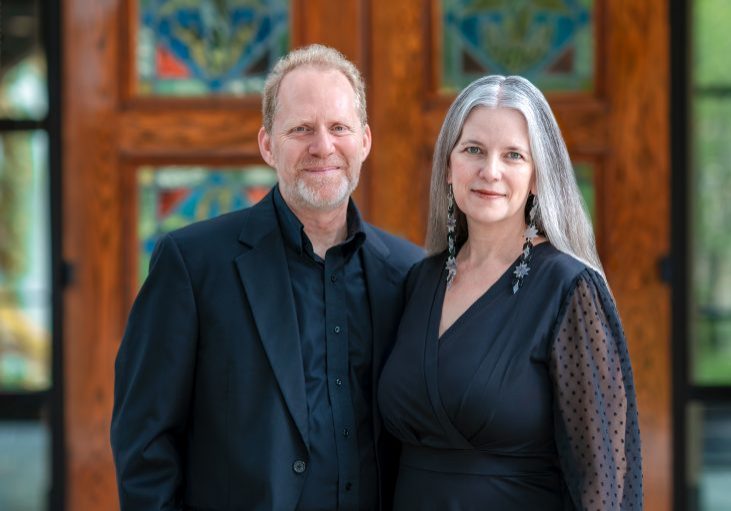
Portrait of Brenda Reynolds at top of page by Linda Dickinson Photography
Did you know?
The University of Regina is a leader in child trauma research? The Child Trauma Research Centre conducts innovative, strength-based, and trauma-integrated research to develop policies that enhance well-being for children and youth, and the adults in their lives. The CTRC focuses on supporting children, families, and communities to bridge the gap between research and real-world impact.
Learn more.
[post_title] => Recognized for a career of trauma-informed care
[post_excerpt] =>
[post_status] => publish
[comment_status] => open
[ping_status] => open
[post_password] =>
[post_name] => recognized-for-a-career-of-trauma-informed-care
[to_ping] =>
[pinged] =>
[post_modified] => 2025-12-04 10:04:05
[post_modified_gmt] => 2025-12-04 16:04:05
[post_content_filtered] =>
[post_parent] => 0
[guid] => https://www.degreesmagazine.ca/?p=9649
[menu_order] => 0
[post_type] => post
[post_mime_type] =>
[comment_count] => 0
[filter] => raw
)