WP_Post Object
(
[ID] => 10229
[post_author] => 20
[post_date] => 2026-09-16 15:35:19
[post_date_gmt] => 2026-09-16 21:35:19
[post_content] =>
Marc Mueller BBA'13 had a unique upbringing; His earliest memory is running around the locker room of the Saskatchewan Roughriders. His dad, Larry, was the assistant general manager of the Riders, and his grandfather, Ron Lancaster, was an iconic player and coach, so Mueller had access to places kids rarely get to go. "My grandfather was the head coach in Edmonton in the 90s. And I remember my favorite place to go was the locker room. Just being able to be around the guys-they were larger than life to me," he remembers. "I got to play crib and help out, do stuff at practice and learn, sit in meetings and things like that. It was a very cool upbringing."
So, it's no surprise that Mueller followed in his father's and grandfather's footsteps to become part of the Riders team as a coach. "It's been kind of the family business. And it's always been a part of my life," he says.
Mueller's journey to the CFL began at Sheldon Williams Collegiate in Regina, followed by football camps with the Regina Rams. Then, he attended the University of Regina, where he was a quarterback for the Rams from 2007-12. "To be able to be the young kid that came to the Rams football camps and then play for the team and coach at the Rams camps was pretty special," he says.
Just as in childhood, Mueller's favourite memories of the Rams is hanging out with the other players, this time in the Rams' clubhouse. "Having the clubhouse attached to the university is a big deal because in between classes, we would all go back to the clubhouse. And whether it was to study or play cards or work out, we were together a lot. I spent a lot of time in that clubhouse, and it's still very special to me," he recounts. He continues to stay in touch with the guys he played with on the Rams. The majority of the groomsmen at his wedding were fellow players, and he also frequents businesses operated by former Rams. "Not a day goes by that I don't look back and reflect on all the positives and all the fun I had as a Ram."
Mueller sees the Regina Rams as an important training ground for future CFL players and coaches: "It's very player driven-whether it's the alumni giving back to the players or the coach spending extra time with the players. They're well coached, and when they leave the Rams program, they're ready to not only give back to the community, but to perform and make a CFL roster," he says. "Everyone knows about the Rams. It's a good program, and every year it seems to be getting better."
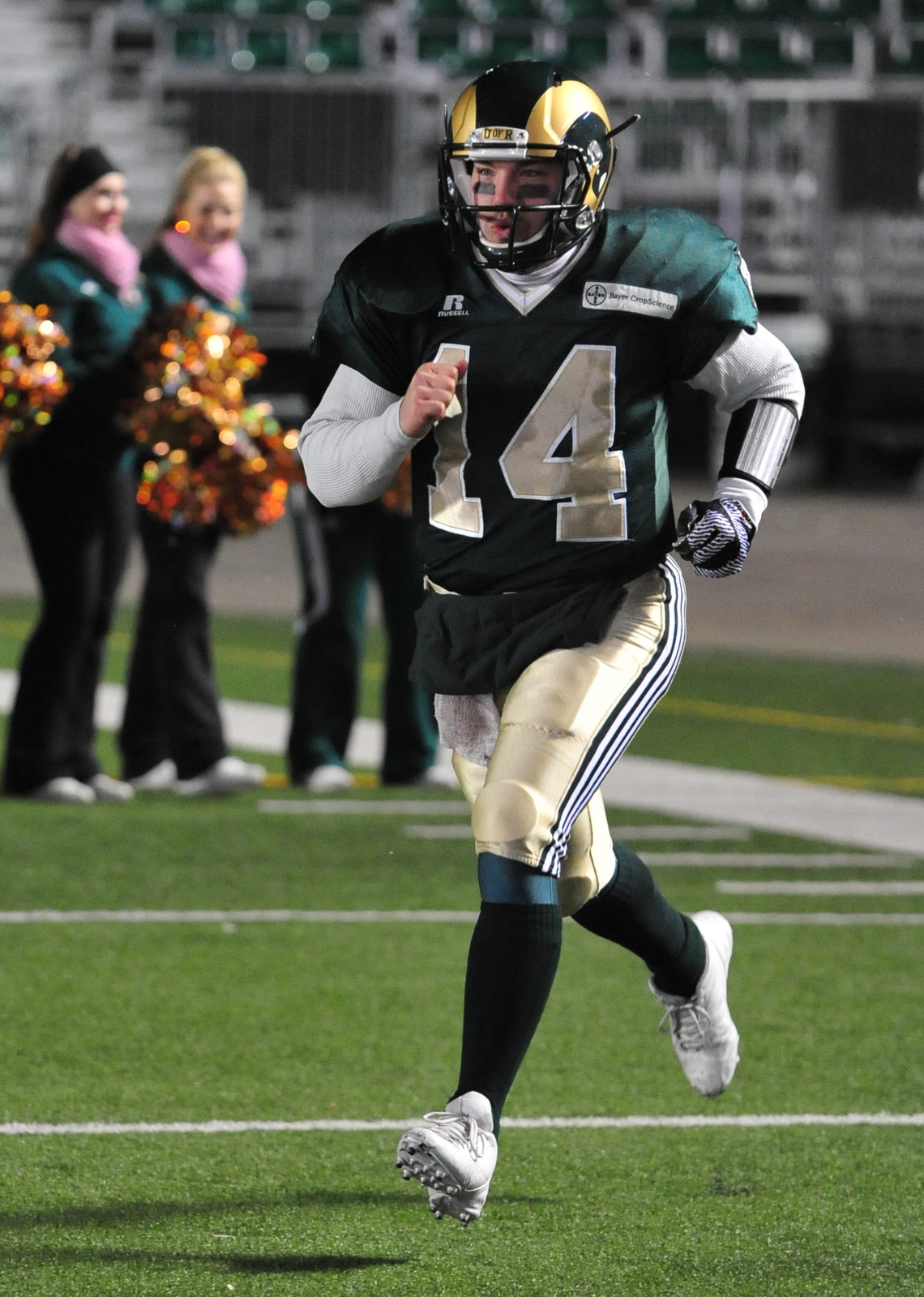
Marc Mueller BBA'13 on the field for the U of R Rams. Photo: U of R Photography
Mueller believes that supporting the Rams makes a major impact on the community. "So many people from programs like the Rams give back to the community, whether it's coaching in high school or coaching sports anywhere," he says. "When you're investing in the Regina Rams, you're not only investing in the team on the field, but you're investing in the young men off the field who will also invest in the community moving forward."
Unfortunately, while Mueller was playing for the Rams in 2011, he got hurt and missed the entire season. But there was a silver lining: head coach Frank McCrystal (who had also coached Mueller's dad when he played with the Rams) and offensive coordinator Bernie Schmidt saw Mueller's potential as a coach. "They let me coach a bit and be a part of the coaching staff to see if I wanted to do it in the future. And I loved it," he recalls. "My whole life, I always wanted to coach. I wanted to play as long as I could and then I wanted to get into coaching right away. I was very fortunate to be able to do that." . After playing one more season upon recovering from his injury, Mueller coached quarterbacks for the Rams for a year. Then he got the call to be an assistant coach for the Calgary Stampeders.
"When you're investing in the Regina Rams, you're not only investing in the team on the field, but you're investing in the young men off the field who will also invest in the community moving forward."
Make a gift to Varsity Sport at the U of R on September 22 - Day of Giving - and double your impact!
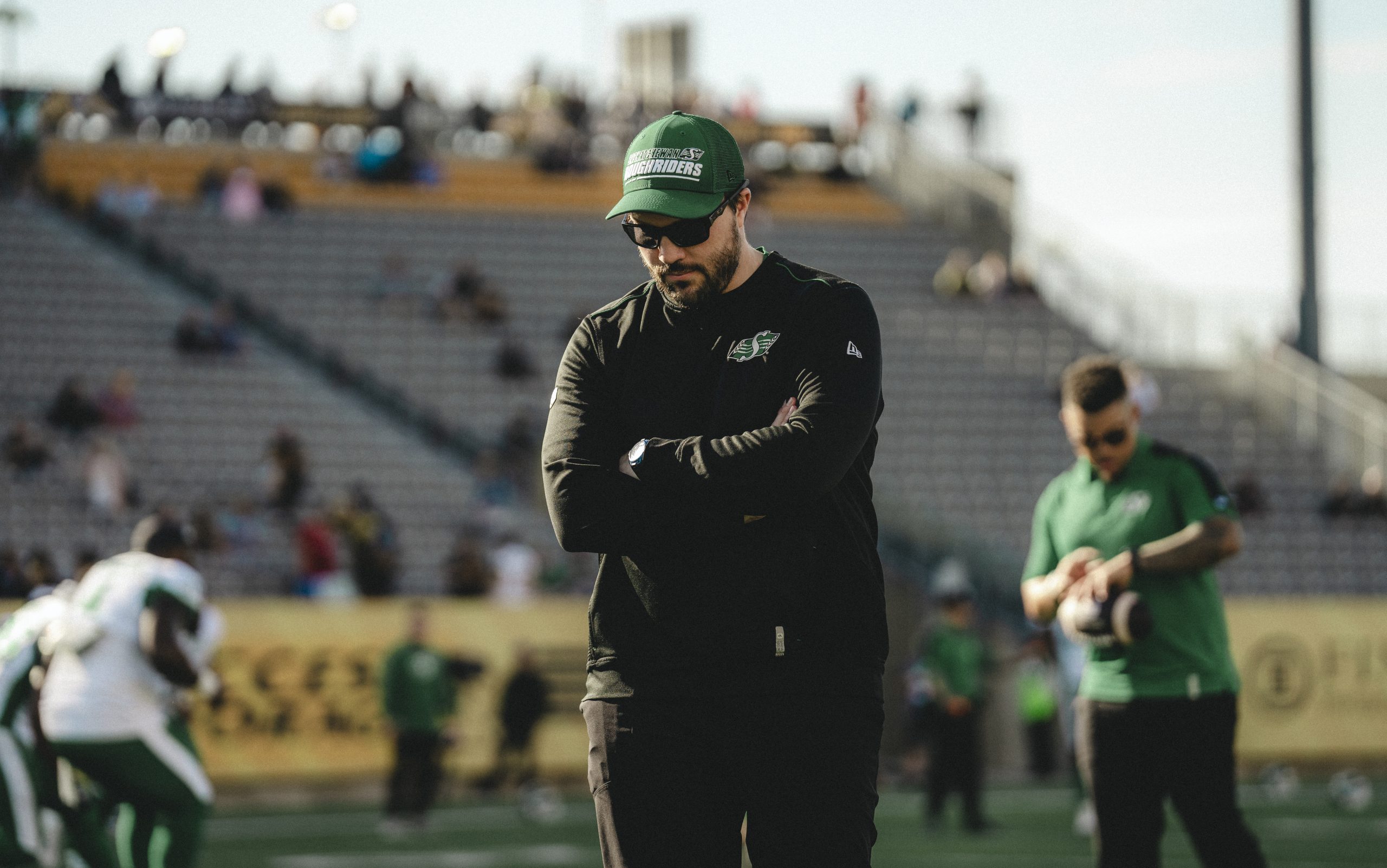
Marc Mueller BBA'13 coaching for the Saskatchewan Roughriders. Photo courtesy Saskatchewan Roughriders
As a CFL coach, Mueller has hoisted the Grey Cup three times in his career (so far): twice with the Calgary Stampeders and most recently with the Saskatchewan Roughriders. He says each experience was unique.
His first Grey Cup win was in his initial year with Calgary in 2014: "It was just such a whirlwind. You're kind of holding on by the seat of your pants, not really knowing what to expect," he says. "And I got to coach defense that year, which I had never done before. That was really an eye-opening opportunity. And I think without that season on defense, I wouldn't have been able to survive on offense the next year. So, I'm very grateful for that."
The second was with the Stampeders, again, in 2018: "We had been there [at the Grey Cup] the previous two seasons and not won. We were the heavy favorites in those two games. And to finally get back and do it was pretty special."
And then there was the 2025 win with the Saskatchewan Roughriders: "Obviously, this past year was amazing. I was lucky enough to come with Corey Mace [Roughriders' head coach], back to Regina, to move back to Regina with a family," he says. "My family lives here. My wife's family lives here. Everybody's here. Coaching is hard on the families-I'm not around a whole bunch for the seven or eight months of the season. So, to win it is truly a family honour or family award. And to see them enjoy it was my favorite part."
Saskatchewan Roughriders' Grey Cup wins are a bit of a family business as well. The family has been involved in three out of five Grey Cup wins in the Riders' history: his grandfather in1966; his father in 1989; and now Mueller.
Now that Mueller has a family of his own, he's continuing traditions that started in his own childhood. "Now, I get to take my children to Mosaic Stadium and let them run around the locker room or the field, and my parents come as well," he says "My daughter gets to look at the Grey Cup photos in the coaches' offices, and there's a picture of her great grandfather, Ron, her grandpa, Larry, and now there's a picture of me, which is pretty cool. I feel like I had the best childhood ever. And I hope that my kids can have the same thing now that I'm involved."
Banner image: Marc Mueller BBA'13 coaching for the Saskatchewan Roughriders at Mosaic Stadium. Photo courtesy Saskatchewan Roughriders.
[post_title] => Marc Mueller BBA’13
[post_excerpt] =>
[post_status] => publish
[comment_status] => open
[ping_status] => open
[post_password] =>
[post_name] => marc-mueller-a-family-business
[to_ping] =>
[pinged] =>
[post_modified] => 2026-09-16 17:11:48
[post_modified_gmt] => 2026-09-16 23:11:48
[post_content_filtered] =>
[post_parent] => 0
[guid] => https://www.degreesmagazine.ca/?p=10229
[menu_order] => 0
[post_type] => post
[post_mime_type] =>
[comment_count] => 0
[filter] => raw
)
WP_Post Object
(
[ID] => 10400
[post_author] => 20
[post_date] => 2026-10-16 11:46:47
[post_date_gmt] => 2026-10-16 17:46:47
[post_content] =>
It's National Library Month (and at press time, Saskatchewan Library Week), an opportunity to celebrate libraries and everything they make possible. It's a perfect time to visit your local branch, pick up some fall reading material - and, as happy coincidence would have it, welcome alum Beth Côté BA'00 to her new role as of CEO of the Regina Public Library!
Beth comes to the job with more than 16 years of public library experience in Saskatchewan, most recently as Director of Public Services at the Saskatoon Public Library. Beth made some time in advance of her first week on the job to chat with Degrees about the role of libraries in building community, the pleasures of lifelong learning, and what she's looking forward to as she returns to the library system that first stoked her love for libraries when she was a kid growing up in Regina.
What do you think public libraries do for communities?
Public libraries are a place where anyone is welcome to go. You don't need to buy anything. You don't need to belong to any specific club or group or have a membership. Anyone can go there to access information, or just spend their time in pursuit of whatever interest they have. I don't think there are a lot of places where it's okay to go by yourself, meet somebody there, and then spend all day reading: each of you in your own pursuits, but together.
I often see people in public libraries from different backgrounds, doing different types of things, in a space together. It's very meaningful for strengthening that fabric of our community.
What drew you personally to work in libraries?
One of the important things that I feel my years at U of R gave me is an opportunity to try many different disciplines - math to business classes, to Latin, to theatre courses. I was also able to do an exchange in Northern England, and all of that started to show me what was possible. I kind of got bitten by the bug of lifelong learning - like, what if we all just kept learning?
As time went on, I did a master's in English and creative writing at Concordia University in Montréal. And when I was finished, I realized that my passion was to move into an area where everyone was welcome to learn about whatever they were interested in at any given time, free of charge. I was fortunate to have a fellow graduate who said they were thinking about library school. And it just snapped; I thought, What do you mean? Is that something you can do? Library studies married a lot of those passions for community building, placemaking, and my interest in lifelong learning and intellectual freedom.
It seems like a great job for a person who has a really broad interest base - and an amazing thing for a person who likes to go down rabbit holes.
It's true. Public libraries are often that first place where a child seeks their own interests outside of what an adult has shown them: not just what's on their parent's shelves, or something that a teacher recommends. Those are also great ways for kids to find their interests, but in a public library, children are the customers themselves.
I'm not sure I would have pursued all the different interests that I have in my lifetime if I didn't have that free access to taking a deep dive into various topics through libraries, because you may not even know what you're looking for until you start looking. But the library has it all there.
In what ways do you think that the roles of public libraries and librarians have changed?
It depends on where you put the frame. Public libraries are about access to information. They're about community building. They are welcoming spaces. Public libraries are champions of intellectual freedom and providing community environments. What ends up changing is that we face different economic realities, changing information landscapes, and technological changes. There are also safety and security issues in public places in general, the types of pressures that come from outside of public libraries, and the shifting needs of the community.
We have to look at how we provide those common services around access to information. We know things change but the core of what we do stays the same. The public library must reflect its community. We always have to be reevaluating what it is that the community needs, making sure that we're paying attention, hearing what it is that the people of Regina want from their library and making sure we respond to those things while keeping our core values in place.
What do you wish more people knew about public libraries?
Today's library is a vibrant, modern service that offers books and more. As busy adults we can start to think nostalgically about the library as a thing of the past, and that they're no longer relevant. But people need that welcoming community space, the books, and the free programming at different times in their lives: when they have children, later in life after they've retired... Even if we're not necessarily using the library right now, we can think about the times when we have used the library and when we might need it again, because it's always there for us.
It's a nice full circle that you're now leading the library you used to visit as a child.
I know. I'm pretty excited about this new position and getting to meet the RPL team that has been doing all the good work at RPL, getting to understand their goals and what they've been working on, and then really getting to know the community in Regina again. I haven't lived in Regina for a couple of decades and I'm looking forward to reacquainting myself with the community, getting to know the people who call Regina home, what their wants and needs are, what they're looking for in their library, and really getting a sense of what the public library means, or could mean, to the people of Regina. It's particularly exciting for me to be able to return to the library system that taught me what a public library is; the one that actually built that passion for me.
This interview was condensed for length and clarity.
Photography: Trevor Hopkin, University of Regina Photography
[post_title] => Beth Côté BA'00 takes the reins at the Regina Public Library
[post_excerpt] =>
[post_status] => publish
[comment_status] => open
[ping_status] => open
[post_password] =>
[post_name] => beth-cote-ba00-takes-the-reins
[to_ping] =>
[pinged] =>
[post_modified] => 2026-10-16 12:00:03
[post_modified_gmt] => 2026-10-16 18:00:03
[post_content_filtered] =>
[post_parent] => 0
[guid] => https://www.degreesmagazine.ca/?p=10400
[menu_order] => 0
[post_type] => post
[post_mime_type] =>
[comment_count] => 0
[filter] => raw
)