


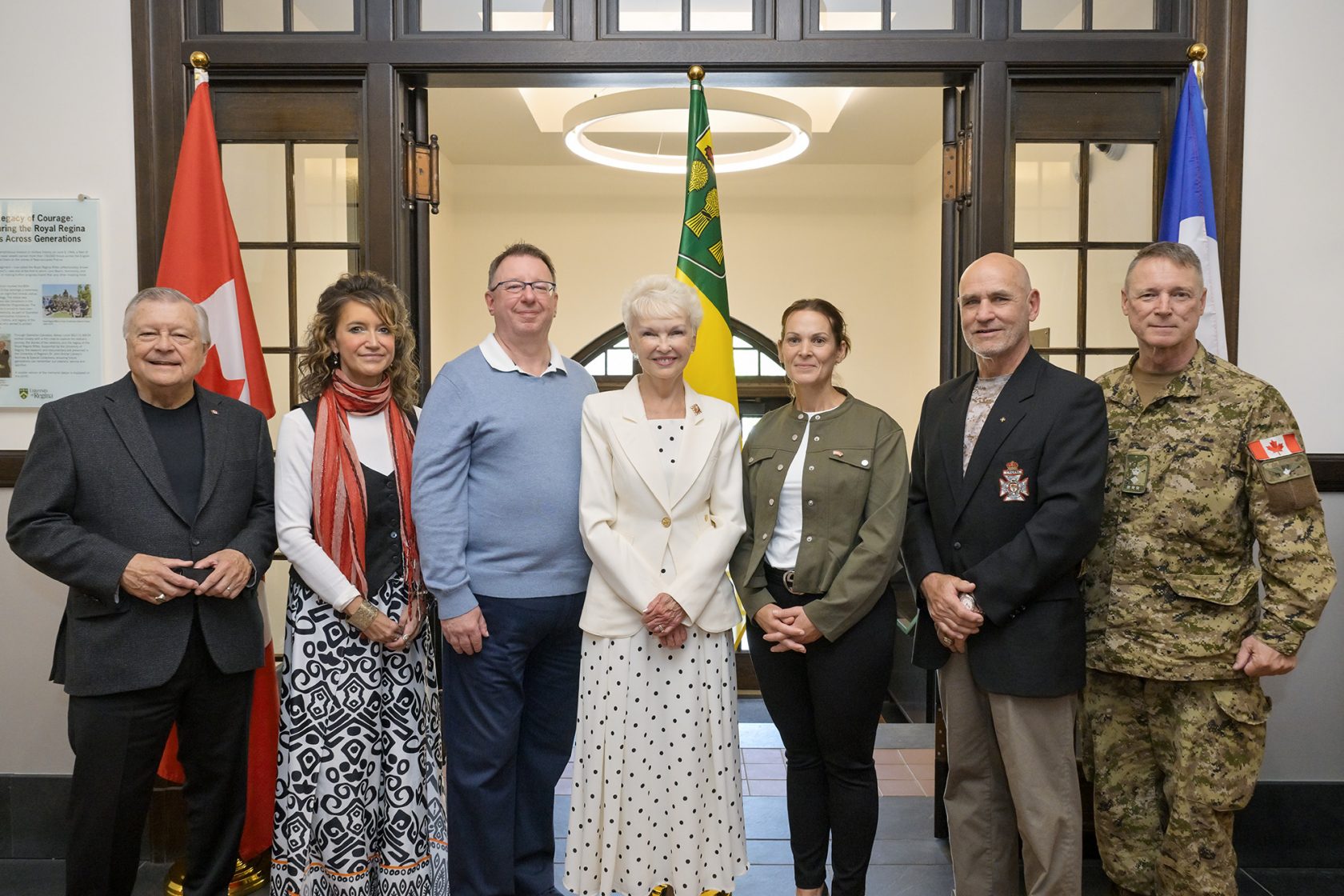
More than 82 years ago, on June 6, 1944, the Regina Rifles landed on Juno Beach as part of the largest amphibious invasion in military history. To commemorate the sacrifices of these citizen-soldiers from all over Saskatchewan, the RRR Trust raised funds to install a statue in Normandy that was unveiled on June 5, 2024, by RRR Colonel‑in‑Chief Her Royal Highness Princess Anne. The eight-foot-tall bronze statue was created by world-renowned sculptor Don Begg.
Unveiling the statue was one of the highlights of a ten-day Tour of Honour in 2024 that allowed current and retired members and supporters of the Rifles to visit several sites that form part of the regiment’s history on D-Day and the ensuing battles in the fall of 1944, as well as some sites from the First World War.
Kelsey Lonie BEd’15, MA’24 embarked on her work as military historian on the Operation Calvados project while a graduate student at the University of Regina. Her goal was to bridge the gap between the military and the public and look for connections that made the commemoration of the Regina Rifles’ contributions meaningful. Through her research, she learned how widespread the stories of the Regina Rifles are in Saskatchewan and how close to home their service was for many people across the province. “They pulled soldiers from all across Saskatchewan,” Lonie says. “I got to dig into some of the stories and understand that these were not hardened career soldiers — these were doctors, farmers, teachers, hunters and gatherers who felt compelled to join the service, whether they were to return or not return. Looking at how that affects the next generation in Saskatchewan, we’re not that far removed from it at all.”
Lonie also supervised history honours student Emily Reid, who travelled to Normandy with her to document the 80th anniversary activities and create a digital time capsule for the University of Regina’s Dr. John Archer Library &Archives. “It was incredible to be able to go to Juno Beach and some of the other battlefields,” Reid says. “I never thought I’d see them, much less have it be part of my schooling.”
The RRR representatives were welcomed to Normandy in the same spirit with which they were greeted when the Rifles liberated communities eight decades prior. “The effort they put into remembering the Canadians who were part of their liberation from the German army, seeing the Canadian flags in the windows, seeing a person there dressed up in a Regina Rifles uniform — it was incredible,” Reid says.
Meeting people who had been liberated was equally moving for Lonie. “It shows the impact of folks going over and fighting for a country that’s not theirs and liberating people who had been under Nazi tyranny for years, who were starving, tired, oppressed,” she says.“ Those stories live on in the lives of the children and grandchildren. People still remember the liberation—they’re elderly now—the gratitude and their act of remembrance is touching and reinforces the reason why we’re all doing this.”
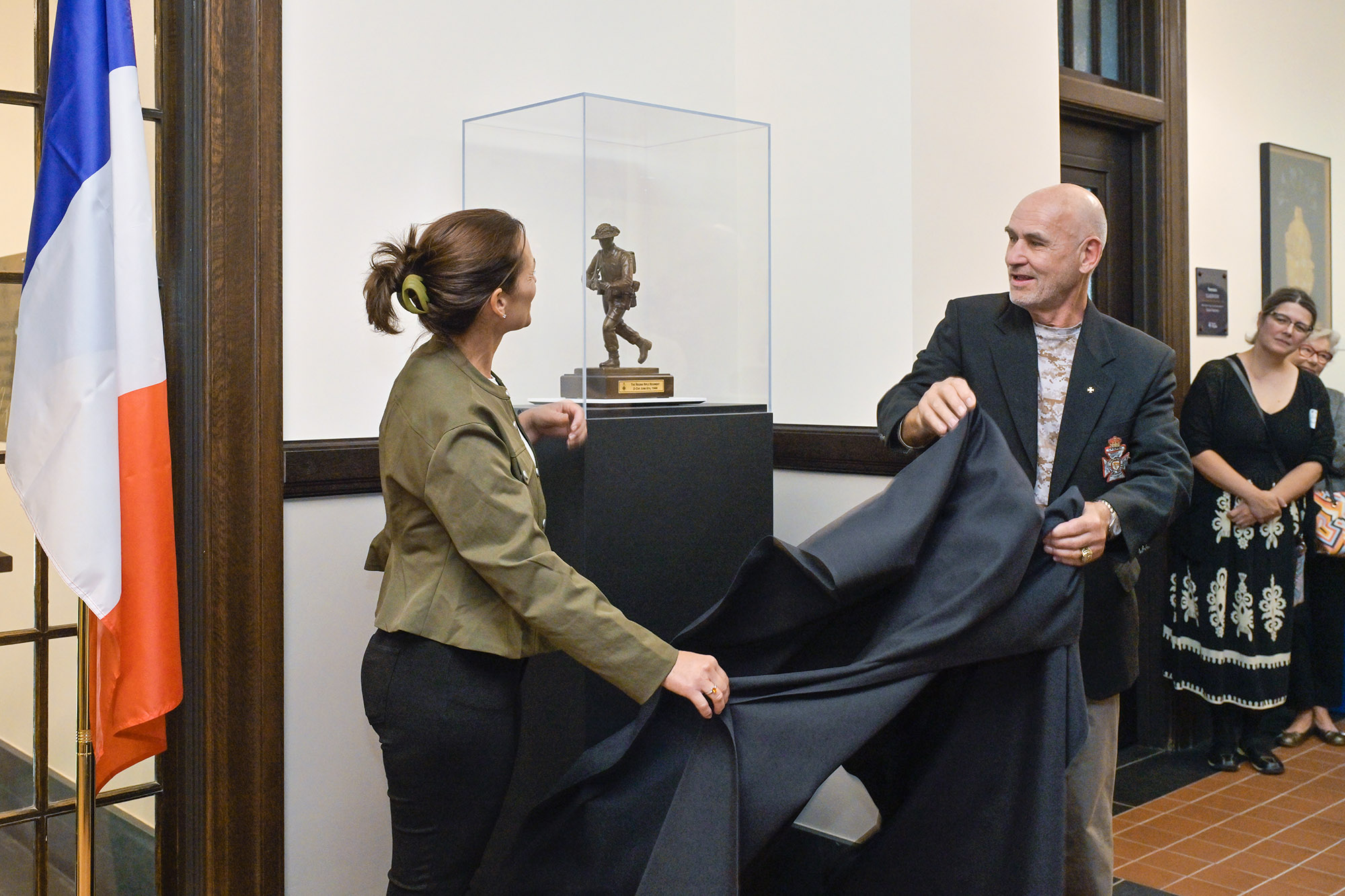
The RRR delegation met members of the Up the Johns! Association, a French group dedicated to remembering the Regina Rifles’ role in securing their freedom. Representatives from that group made a reciprocal visit to Saskatchewan in September 2026 to visit the hometowns, farms and loved ones of the soldiers who landed in France during the war. One of their stops was the College Avenue Campus, where they helped unveil a scale maquette of the memorial statue installed in Normandy.
Honouring the history and legacy of the Regina Rifle Regiment
Operation Calvados was a three‑phase plan to honour the history and legacy of the Regina Rifle Regiment—now the Royal Regina Rifles (RRR)—one of the first Canadian regiments to storm Juno Beach at Normandy on D‑Day in 1944. The project had three phases: 1) installation of a memorial statue commemorating the RRR on Juno Beach, 2) a Tour of Honour where retired and active RRR members went to Normandy and followed in the footsteps of the soldiers as they fought to liberate France, and 3) a legacy piece that includes the Operation Calvados documentary and recognition of the RRR on the University of Regina College Avenue Campus.
First presented to President Jeff Keshen in November 2024 at the premiere of of the documentary, Operation Calvados, it is now part of the President’s Art Collection. The maquette’s installation, along with an accompanying plaque was made possible through the support of the University of Regina Alumni Association, honouring more than 200 Second World War service personnel who were affiliated with the University of Saskatchewan’s Regina College, the predecessor of the University of Regina.
“A lot of the soldiers in the Regina Rifles either left their education behind to serve in the Second World War or they made use of their benefits upon returning from the war to then go to school,” Lonie notes. “It reminds us that soldiers came from everywhere — they were students that you might have passed in the hallway.”
Reid worked under the supervision of Crista Bradley, University Records & Information Management Archivist at the Dr. John Archer Library and Archives to research some of the people whose names appear on the Regina College Second World War scroll. “People engage with history in a more meaningful way when they can make a tangible connection to it,” Bradley says. “When we can see that it’s people like us who left their homes, families, jobs and put everything on pause to serve our country and the people in it, I think it resonates. It’s a powerful way to help ensure people don’t forget the sacrifices made.”
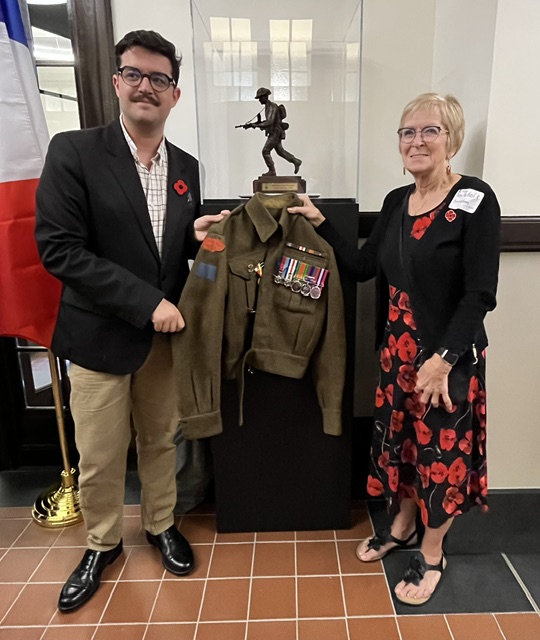

Bev Pacholik attended the unveiling of the maquette and plaque at the College Avenue Campus. It was particularly poignant for her, as her father was one of the Regina Rifles who stormed Juno Beach on D-Day. She brought his RRR tunic with her, which she also took to France when she attended the 80th and 82nd anniversary celebrations there. “(Bringing his tunic) was one way that my dad could be among the people who continue to show such gratitude to the Rifles,” Pacholik says. “Children and adults would approach me to admire, hold and sometimes try it on. Dad would have loved that! It started many heartwarming conversations just as it has here in Regina. My dad would be humbled, honoured and very proud of this wonderful legacy of remembrance. Their spirit lives on.”
Banner image (l-r): The Honorable Ralph Goodale BA’71, LLD’26; Jennifer Murray BA’03, Med’05, MAdmin’22, past URAA president; Brett Waytuck, Dean, University Libraries and Archives; Bernadette McIntyre, SOM, BAdmin’80, BA’81; Dr. Ellyn Lyle, Provost and Vice-President (Academic); Retired Lieutenant-Colonel Ed Staniowski; Lieutenant-Colonel Kevin Barry, MMM, CD, Commanding Officer, Royal Regina Rifles. Photography: Trevor Hopkin, University of Regina Photography

Beth Côté BA’00 takes the reins at the Regina Public Library
Read More