WP_Post Object
(
[ID] => 10085
[post_author] => 21
[post_date] => 2026-06-22 14:31:45
[post_date_gmt] => 2026-06-22 20:31:45
[post_content] =>
When Ralph Goodale stepped off the plane in London in April 2021, he knew his tenure as Canada's High Commissioner to the United Kingdom would be challenging. The United Kingdom had officially left the European Union the year prior; the global economy was in the midst of weathering the COVID-19 pandemic; and there was a major evacuation of civilians from Afghanistan, creating international migration challenges-to name just three examples. Then, less than a year into his post, Russia invaded Ukraine, triggering a sudden influx of more than a million applications from Ukrainians seeking approval to relocate to Canada. All that paperwork went through Goodale's Canada House embassy in London. "It's a very busy post-the second largest Canadian diplomatic mission in the world, and the oldest," says Goodale. And, even with the political, economic and social turmoil, an incredibly rewarding one. "Your job is to make sure the bonds, linkages and functionality of the relationships between Canada and the UK are working successfully. So far, it's turned out rather well. The turbulence continues, but the good, solid, working relationship has been an important thing to make sure we always get right. It's something you never take for granted; you always have to keep working on it."
As High Commissioner, Goodale served as the ambassador from Canada to the United Kingdom, managing bilateral relationships between the two countries. These include everything from political and diplomatic issues to commercial trade and investment to cultural events and scientific exchanges. There is also a defense, security and intelligence component to the role. Goodale notes that the level of economic exchange between Canada and the UK is huge-almost $600 billion-and growing, now that Canada is further diversifying its trade and investments beyond North America. "But it's more than dollars and cents. The way we collaborate with one another transcends politics," he says. "There is a huge amount of understanding, knowledge, trust and respect between our two countries. Our instincts are largely the same, based on the fundamentals-freedom, democracy, human rights and dignity, compassion, fairness, due process, the rule of law-that we have promoted and defended together in the world for a very long time."

The view from the High Commissioner's office in Canada House, overlooking Trafalgar Square.

Goodale also sat on the Commonwealth Board of Governors with high commissioners from 55 other Commonwealth countries. "These are an important set of potential allies for Canada, though we're not always on the same page as all of them," he explains. For example, the relationship between Canada and India has been tense over the last few years. "It was important during that period of anxiety and disruption for communications to continue to flow. I'm pleased to say that the Indian and Canadian High Commissioners in London had a very good, direct relationship, and we could keep communications flowing despite the legal and diplomatic problems between our nations. Now, the relationship is rejuvenating itself. There's still a lot of work to do. Part of the process of rebuilding is making sure we can have a productive relationship that is also fully respectful of the rule of law. That's absolutely fundamental to our relationship with India and every other country."
Goodale's second year at his post saw an enormous amount of royal activity: Queen Elizabeth II celebrated her Platinum Jubilee in spring 2022; there was a state funeral for her in September; and King Charles III ascended to the throne. While the high commissioner is not directly responsible for royal relations-that falls under the portfolio of the prime minister and governor general-Canada House is situated right around the corner from Buckingham Palace. Goodale says that communications between the diplomatic and royal offices paid off in a very significant way for Canada when the King came to open the most recent session of Parliament. "He did so in midst of all the tension around President Trump's comments on the fifty-first state and the establishment of tariffs to weaken our economy," he observes. "The King is a superb diplomat. For him to come personally to open the Canadian Parliament and emphatically celebrate 'The True North Strong and Free'-that was a very important gesture of support from the King of Canada for the independence and sovereignty of the Canadian state."
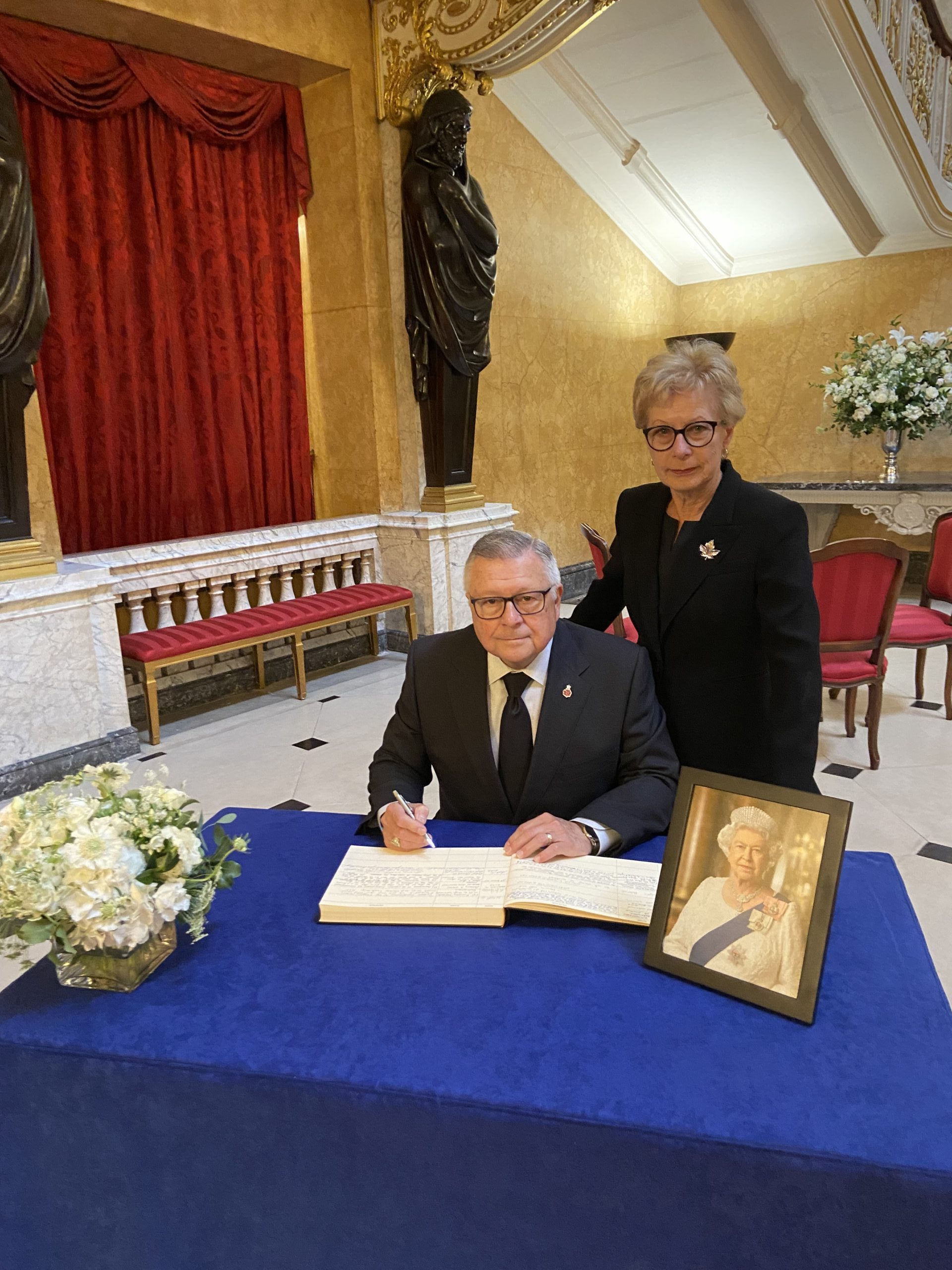
Ralph and Pamela Goodale signing the Book of Condolences for Her Late Majesty, Queen Elizabeth II.
His term as high commissioner came to a close at the end of 2025, after which Goodale and his wife, Pamela, moved back home to Regina. After five months, he was appointed to yet another prominent position, that of a member of the newly formed cross-partisan Advisory Committee on Canada-U.S. Economic Relations. In that role, he and 23 other prominent Canadians serve as key strategic voices advising the prime minister as Canada navigates U.S. trade talks and tariffs. "We've been familiar with a rules-based economic approach between Canada and the U.S. for the past 80 years. Now, all of a sudden, that has changed. The era of greater integration between the Canadian and U.S. economies and the adjudication of disputes according to an agreed set of rules is changing to something else. We don't know yet what that is going to be, and the ground is shifting all the time," he says. "But clearly, the geography has not changed, and we have to have a functional relationship with the U.S. As we build that new relationship, we need to make sure that it doesn't leave us vulnerable, dependent or in a situation where our sovereignty can be questioned."
Goodale says that working through this challenging time is going to take "patience, courage, nimbleness, flexibility and nerves of steel." The advisory committee's objective is to give the government the best possible information on areas of economic opportunity and vulnerability, as well as guidance on improving Canada's leverage and overall bargaining power. "It's not an easy assignment for the committee, but it's even more difficult for the government itself. They actually have to get into those face-to-face negotiations with their American counterparts. The committee is one way Canadians are being asked to provide input into that process. It's a privilege to be able to serve in that way," he says.
The advisory committee has met a few times now, and Goodale is impressed by how the members are all on the same page, despite political, geographical and sectoral differences. "Everyone seems to be pulling in the same direction. There's no scoring of political points-it's all about defending the country. Everyone seems to be really keen on doing the best job that they can in giving the government the most reliable information and the most creative, workable ideas for how we advance Canada's position."
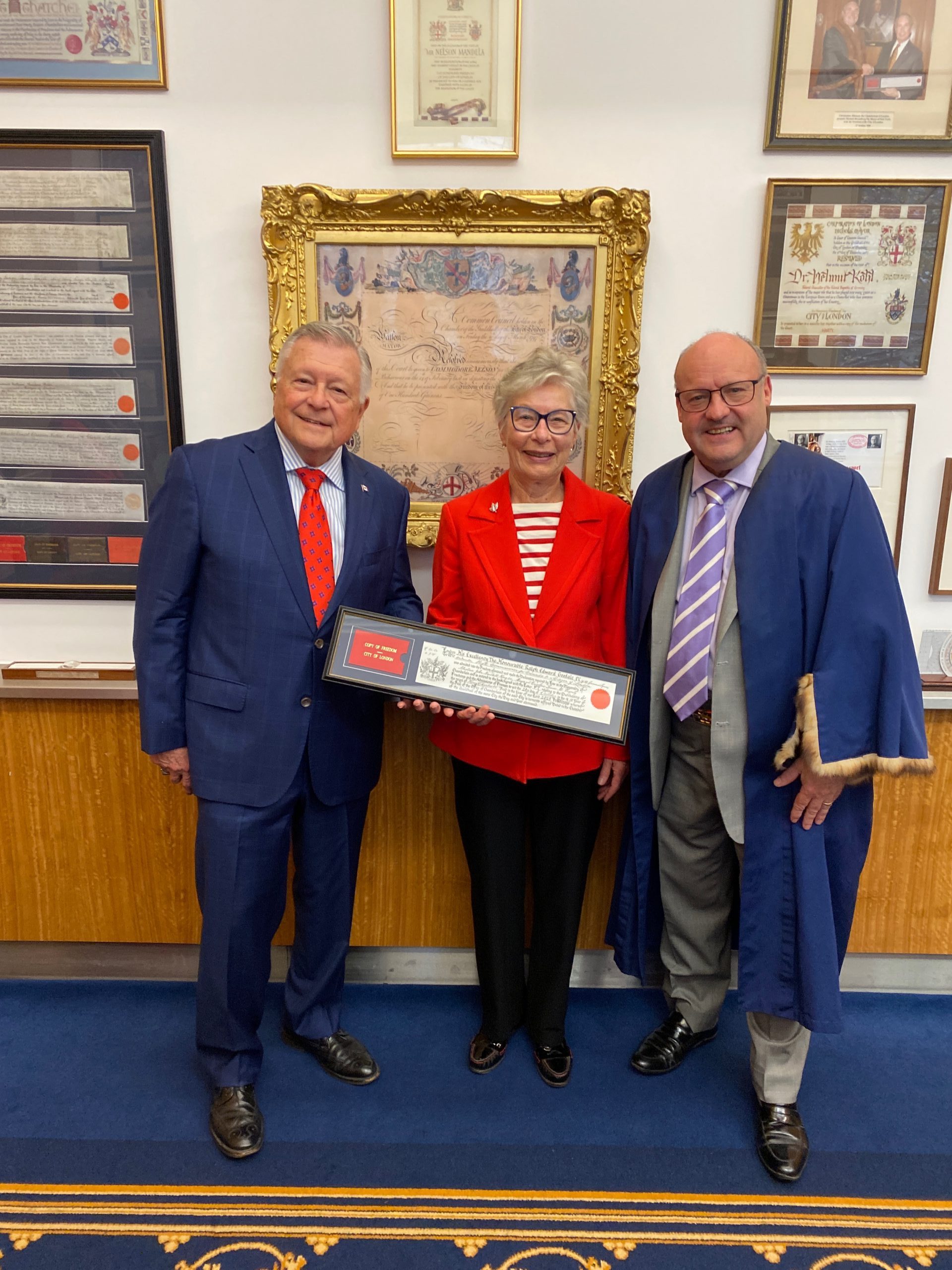
For his contributions to Canada-UK relations, Ralph Goodale has been awarded the "Freedom of the City of London".
In his more than 40 years of public service, Goodale has learned that there are two things that contribute to success in politics, diplomacy and everyday life: "One: Be ambitious. Set your sights as high as you possibly can. Don't start out with only a small goal-make it a large one to accomplish as much as possible," he says. And the second? "Kindness in dealing with people. Whether political friends or adversaries, you can get a lot further and accomplish more of your ambitious agenda if you find ways to work well with people and try to be as kind and respectful as you can of their concerns. In the world of successful politics and diplomacy, you get things done by dreaming big, working hard and treating others with respect."
[post_title] => Ralph Goodale BA'71, LLD'26: A Lifetime of Public Service and Not Slowing Down
[post_excerpt] =>
[post_status] => publish
[comment_status] => open
[ping_status] => open
[post_password] =>
[post_name] => a-lifetime-of-public-service-and-not-slowing-down
[to_ping] =>
[pinged] =>
[post_modified] => 2026-09-16 17:01:23
[post_modified_gmt] => 2026-09-16 23:01:23
[post_content_filtered] =>
[post_parent] => 0
[guid] => https://www.degreesmagazine.ca/?p=10085
[menu_order] => 0
[post_type] => post
[post_mime_type] =>
[comment_count] => 0
[filter] => raw
)
WP_Post Object
(
[ID] => 10124
[post_author] => 20
[post_date] => 2026-08-18 17:36:20
[post_date_gmt] => 2026-08-18 23:36:20
[post_content] =>
Karlie Butler has always been a dog person, but it wasn't until he took a sabbatical from his position at the University of Regina in 2017 - 18 that he got serious about them. "In addition to my sabbatical activities, I started volunteering at the Regina Humane Society (RHS), walking dogs. I began observing dog training classes because I wanted to improve my skills as a volunteer," he says. Not long afterward, he became more interested in training and was accepted into an eight-month apprenticeship, becoming a contract trainer at the RHS in 2018.
The RHS requires its trainers to achieve the "Certified Professional Dog Trainer Knowledge Assessed" credential from the Certification Council for Professional Dog Trainers. This involves hands-on and online learning, including passing an exam. "To maintain the credential, you have to do a certain amount of professional development over the three-year renewal cycle. I work a lot with behaviour rather than obedience and sport, so I prefer to take courses on topics like loose leash walking and behaviour modification to apply them to the training I do," Butler explains. The licensed trainers then pass their knowledge on to dog owners by teaching them to train their own dogs in training classes.
Butler's first experience with dog training was taking his dog, Bella, to classes in about 2016, shortly after he adopted the seven-or eight-year-old chihuahua cross from the RHS. (She recently passed away at the age of 16.) Butler learned firsthand the challenges-and rewards-of having a dog with behavioural issues. "Bella had a lot of anxiety, which made the first two years of owning her not the easiest experience. I took her through foundations training, and she didn't do very well. I was stuck on the idea that she needed to do it again, but the trainer encouraged us to take just a silly tricks class," he says. Butler soon learned that it's possible to teach an old dog new tricks. "She was voted 'most improved' in the tricks class. We had a lot of fun. That experience really changed my attitude toward her. She was driving me a bit nuts before but taking that tricks class and learning little things like 'high five' changed my relationship with her. Little victories gave me the confidence to keep working with her, both on general relationship building and the behavioural concerns at the time."
Butler understands the challenge of having a dog with behavioural issues, and he wants others who may be struggling to know that "behaviour can change. Even if it's stressful or looks impossible right now, that doesn't mean it can't get better." He notes that owners need to be patient and willing to put in the work. "It's like human behaviour: people don't change overnight. Neither do dogs. But there's hope and potential for things to improve. It's easy to get stuck just seeing the behavioural problems with your dog," he says. "Of course, work on the behaviour but also look past the behaviour and have fun with them when you can."
Butler sees parallels between dealing with dogs and people in everyday life. "You don't always know-whether it's a dog or a person-what someone's going through, what's going on in their heads, what might be difficult or challenging for them," he says. "You need to have an open mind and be understanding. Patience is a large part of working with dogs, especially dogs with behavioural struggles. And as stressors in the world for people increase, you need to have a willingness to be adaptable and approach things in different ways-it's not 'one size fits all."
For those interested in becoming a dog trainer, Butler suggests connecting with a current trainer and shadowing them. "Having a mentor is essential to learning that side of dog training. Then apply what you're learning wherever you can-with your own dogs or volunteering with dogs at places like the RHS," he says. "Finding opportunities to work with dogs is important. Volume doesn't equal skill, but volume offers the opportunity to practice skills. This is really applied knowledge."
As National Dog Day reminds us, the bond between humans and dogs is worth investing in. And if you're struggling with a dog whose behaviour feels overwhelming, Butler's advice is simple: find help and put in the work, but also be patient, look past the problem, find the fun and trust that things can get better. Because, after all, even an anxious chihuahua can learn to high five.

Karlie Butler BA'04 and friend at the Regina Humane Society's former home on Armour Road in 2018.
Five tips for bringing a new dog into your home
Fall is a great time to welcome a new canine friend to your home; it's still warm enough to get some solid outdoor training time, and a good opportunity to incorporate your dog into work and school routines. Karlie offers five tips for making that transition a smooth one.
- Remember the 3-3-3 rule: 3 days to decompress, 3 weeks to learn routine and 3 months to feel at home.
- Give them space and don't force interaction.
- Set clear and consistent routines right away.
- Praise and reward behaviours you want to continue.
- Pet-proof your home to minimize accidents or initial unwanted behaviours
Banner image: Karlie Butler BA'04 on the University of Regina main campus. Photo: Trevor Hopkin, University of Regina Photography.
[post_title] => Ask an alum! Karlie Butler BA’04 turns a love of dogs into service to community
[post_excerpt] =>
[post_status] => publish
[comment_status] => open
[ping_status] => open
[post_password] =>
[post_name] => ask-an-alum-karlie-butler-ba04-turns-a-love-of-dogs-into-service-to-community
[to_ping] =>
[pinged] =>
[post_modified] => 2026-09-16 17:00:38
[post_modified_gmt] => 2026-09-16 23:00:38
[post_content_filtered] =>
[post_parent] => 0
[guid] => https://www.degreesmagazine.ca/?p=10124
[menu_order] => 0
[post_type] => post
[post_mime_type] =>
[comment_count] => 0
[filter] => raw
)